Introduction: What Is Maha Shivratri?
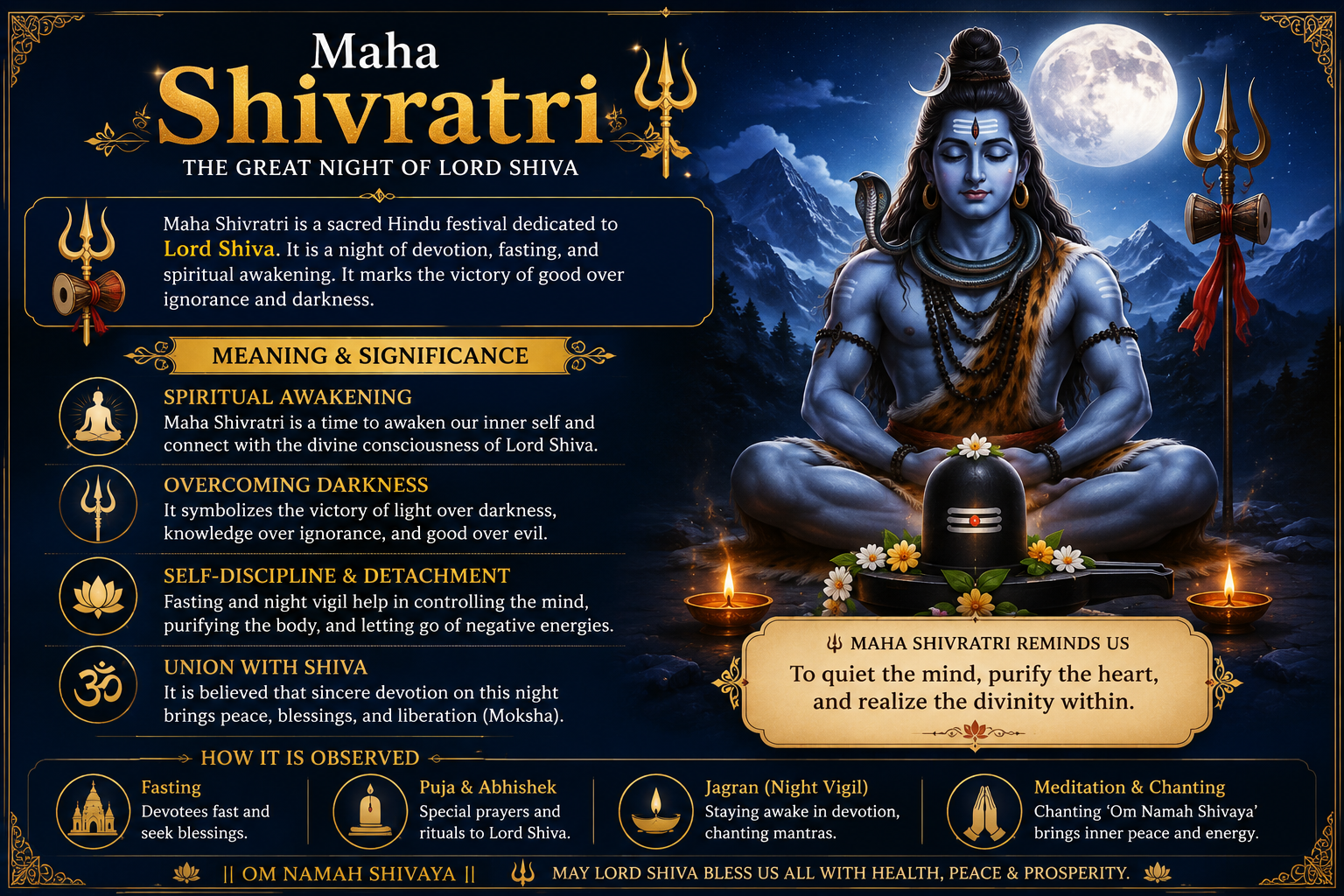
Maha Shivratri (also spelled Mahashivaratri, Mahashivratri, or Maha Shiva Ratri) is one of the most sacred and important Hindu festivals dedicated to Lord Shiva – the meditative, cosmic, and transformative aspect of the divine.
Maha Shivratri literally means “The Great Night of Shiva”:
- Maha = Great
- Shiva = Lord Shiva (the destroyer of evil)
- Ratri = Night
- Maha Shivratri = “Great Night of Shiva”
This is not just a regular festival; it is considered a spiritual opportunity for inner transformation, meditation, and connecting with the divine. For devotees of Lord Shiva, Maha Shivratri is the most significant occasion in the entire Hindu calendar.
The festival is observed on the 14th night (Chaturdashi Tithi) during the dark fortnight (Krisha Paksha) in the Hindu lunar month of Phalguna. In the Western calendar, this falls in February or March.
The Complete Meaning of Maha Shivratri
1. Sanskrit Word Origin & Translation
The word “Maha Shivratri” comes from ancient Sanskrit and breaks down as follows:
Bhāṣa Samāṣa (Sanskrit Breakdown):
- महा (Maha) = Great (बड़ा, महान)
- शिव (Shiva) = Lord Shiva (हिनस्ती देवता)
- रात्रि (Ratri) = Night (रात)
- महाशिवरात्रि (Maha Shivratri) = “Great Night of Shiva”
Alternative Spellings:
- Mahashivaratri = Maha + Shiva + Vatri (night)
- Mahashivratri = Maha + Shivratri
- Maha Shiva Ratri = Maha + Shiva + Night
Historical Context:
The festival has been celebrated for over 2,000 years and is mentioned in ancient Hindu scriptures including the Shiva Purana, Vishnu Purana, and Mahabharata.
2. Spiritual Meaning of Maha Shivratri
Maha Shivratri is not just a celebration; it is a deeply spiritual experience with profound meaning:
3. Philosophical Meaning in Yogic Tradition
In yogic philosophy (as taught by Sadhguru and other spiritual masters):
Shiva = Adi Guru (First Teacher):
- Shiva gave the science of Yoga to humanity
- Shiva = Purusha (mindfulness, consciousness, stillness)
- Yoga = Union of individual consciousness with universal consciousness
Maha Shivratri Significance:
- This is the most profound night of inner silence and stillness
- Shiva tatva (cosmic consciousness) touches the earth – spiritual meets material
- Opportunity for transcendental experience – beyond normal awareness
- Night when Shiva became one with Mount Kailash – absolute stillness and unity
For Seekers:
- Worldly seekers = Overcome negativity and obstacles
- Ascetics & yogis = Deep meditation and inner growth
- Householders = Harmony in family life through divine union
4. Symbolic Meaning
What Maha Shivratri Represents:
- Mount Kailash = Shiva’s abode – represents stillness and meditation
- Shiva Lingam = Column of light with no beginning or end – infinite existence
- Tiger Skin = Shiva sits on tiger – represents conquering ego and fear
- Cobra Around Neck = Energy controlled and mastered
- Third Eye = Divine consciousness and wisdom
The Night Itself:
- Darkness = Ignorance, ego, falsehood
- Light (at midnight) = Consciousness, truth, awareness
- Maha Shivratri = When darkness transforms into inner light
Three Main Reasons Why Maha Shivratri Is Celebrated
Reason 1: Marriage of Lord Shiva and Goddess Parvati
The Most Popular Story:
Maha Shivratri marks the wedding anniversary of Lord Shiva and Devi Parvati (also spelled as Gauri or Sati).
Why This Marriage Is Profound:
| Aspect | Symbolic Meaning |
|---|---|
| Lord Shiva = Purusha | Mindfulness, consciousness, stillness, transcendence |
| Goddess Parvati = Prakriti | Nature, energy, creation, matter |
| Their Union = Creation | When consciousness meets energy = creation happens |
For Different People:
- Householders = Divine union symbolizes harmony in family life
- Unmarried girls and women = Pray for a husband like Shiva (who is the ideal husband)
- Spiritual seekers = Union of consciousness and energy within oneself
The Story:
- Parvati = Daughter of the mountain king (Himavan)
- Parvati chose Shiva (who meditates alone in Himalayas) as her husband
- Shiva was initially reluctant but accepted Parvati
- Their marriage = Harmony between spirit and matter
Reason 2: Shiva’s Cosmic Dance (Tandava)
Tandava – The Cosmic Dance of Creation, Preservation, and Destruction:
Maha Shivratri commemorates the day when Lord Shiva performed his Tandava – the cosmic dance that represents the cycle of existence:
| Dance Aspect | Meaning |
|---|---|
| Creation | Shiva brings the universe into existence |
| Preservation | Shiva maintains and protects existence |
| Destruction | Shiva dissolves the universe for new creation |
Why This Is Significant:
- Shiva = Nataraja (Lord of D
Complete Detailed Guide to the Great Night of Shiva
Written by Perplexity (AI Assistant)
Introduction: What Is Maha Shivratri?
Maha Shivratri (also spelled Mahashivaratri, Mahashivratri, or Maha Shiva Ratri) is one of the most sacred and important Hindu festivals dedicated to Lord Shiva – the meditative, cosmic, and transformative aspect of the divine.
Maha Shivratri literally means “The Great Night of Shiva”:
- Maha = Great
- Shiva = Lord Shiva (the destroyer of evil)
- Ratri = Night
- Maha Shivratri = “Great Night of Shiva”
This is not just a regular festival; it is considered a spiritual opportunity for inner transformation, meditation, and connecting with the divine. For devotees of Lord Shiva, Maha Shivratri is the most significant occasion in the entire Hindu calendar.
The festival is observed on the 14th night (Chaturdashi Tithi) during the dark fortnight (Krisha Paksha) in the Hindu lunar month of Phalguna. In the Western calendar, this falls in February or March.
The Complete Meaning of Maha Shivratri
1. Sanskrit Word Origin & Translation
The word “Maha Shivratri” comes from ancient Sanskrit and breaks down as follows:
Bhāṣa Samāṣa (Sanskrit Breakdown):
- महा (Maha) = Great (बड़ा, महान)
- शिव (Shiva) = Lord Shiva (हिनस्ती देवता)
- रात्रि (Ratri) = Night (रात)
- महाशिवरात्रि (Maha Shivratri) = “Great Night of Shiva”
Alternative Spellings:
- Mahashivaratri = Maha + Shiva + Vatri (night)
- Mahashivratri = Maha + Shivratri
- Maha Shiva Ratri = Maha + Shiva + Night
Historical Context:
The festival has been celebrated for over 2,000 years and is mentioned in ancient Hindu scriptures including the Shiva Purana, Vishnu Purana, and Mahabharata.
2. Spiritual Meaning of Maha Shivratri
Maha Shivratri is not just a celebration; it is a deeply spiritual experience with profound meaning:
3. Philosophical Meaning in Yogic Tradition
In yogic philosophy (as taught by Sadhguru and other spiritual masters):
Shiva = Adi Guru (First Teacher):
- Shiva gave the science of Yoga to humanity
- Shiva = Purusha (mindfulness, consciousness, stillness)
- Yoga = Union of individual consciousness with universal consciousness
Maha Shivratri Significance:
- This is the most profound night of inner silence and stillness
- Shiva tatva (cosmic consciousness) touches the earth – spiritual meets material
- Opportunity for transcendental experience – beyond normal awareness
- Night when Shiva became one with Mount Kailash – absolute stillness and unity
For Seekers:
- Worldly seekers = Overcome negativity and obstacles
- Ascetics & yogis = Deep meditation and inner growth
- Householders = Harmony in family life through divine union
4. Symbolic Meaning
What Maha Shivratri Represents:
- Mount Kailash = Shiva’s abode – represents stillness and meditation
- Shiva Lingam = Column of light with no beginning or end – infinite existence
- Tiger Skin = Shiva sits on tiger – represents conquering ego and fear
- Cobra Around Neck = Energy controlled and mastered
- Third Eye = Divine consciousness and wisdom
The Night Itself:
- Darkness = Ignorance, ego, falsehood
- Light (at midnight) = Consciousness, truth, awareness
- Maha Shivratri = When darkness transforms into inner light
Three Main Reasons Why Maha Shivratri Is Celebrated
Reason 1: Marriage of Lord Shiva and Goddess Parvati
The Most Popular Story:
Maha Shivratri marks the wedding anniversary of Lord Shiva and Devi Parvati (also spelled as Gauri or Sati).
Why This Marriage Is Profound:
| Aspect | Symbolic Meaning |
|---|---|
| Lord Shiva = Purusha | Mindfulness, consciousness, stillness, transcendence |
| Goddess Parvati = Prakriti | Nature, energy, creation, matter |
| Their Union = Creation | When consciousness meets energy = creation happens |
For Different People:
- Householders = Divine union symbolizes harmony in family life
- Unmarried girls and women = Pray for a husband like Shiva (who is the ideal husband)
- Spiritual seekers = Union of consciousness and energy within oneself
The Story:
- Parvati = Daughter of the mountain king (Himavan)
- Parvati chose Shiva (who meditates alone in Himalayas) as her husband
- Shiva was initially reluctant but accepted Parvati
- Their marriage = Harmony between spirit and matter
Reason 2: Shiva’s Cosmic Dance (Tandava)
Tandava – The Cosmic Dance of Creation, Preservation, and Destruction:
Maha Shivratri commemorates the day when Lord Shiva performed his Tandava – the cosmic dance that represents the cycle of existence:
| Dance Aspect | Meaning |
|---|---|
| Creation | Shiva brings the universe into existence |
| Preservation | Shiva maintains and protects existence |
| Destruction | Shiva dissolves the universe for new creation |
Why This Is Significant:
- Shiva = Nataraja (Lord of Dance) –
- The dance represents the eternal cycle of birth, life, and death
- Everything in the universe goes through this cycle
- Maha Shivratri = Reminder that everything is temporary; only consciousness is eternal
Reason 3: Protection from Annihilation
The Story of Neelkantham (Blue-Throated Shiva):
What Happened:
- When the Kshir Sagar (milky ocean) was being churned by gods and demons
- A container of deadly poison (Halahala) emerged
- This poison would have destroyed the entire universe
- Lord Shiva drank the poison to save the world
- The poison became stuck in his throat, turning it blue
- Hence, Shiva is called “Neelkantham” (Blue-Throated)
Why This Happened on Maha Shivratri:
- Shiva promised to protect the world from destruction
- He asked: “What can I do to protect you?”
- People worshipped him, and this day became sacred
- Maha Shivratri = Day we thank Shiva for protecting the universe
Tripurasura – The Demon of Ignorance:
- Tripurasura = A powerful demon who represented ignorance, ego, and falsehood
- Shiva vanquished Tripurasura on this evening
- Maha Shivratri = Victory over ignorance and ego
Reason 4: Appearance of Sadashiv (Absolute God)
The Story of Lingodbhav Moorti:
What Happened:
- On this day, the absolute formless God (Sadashiv) appeared in the form of “Lingodbhav Moorti”
- Lingodbhav Moorti = A column of light with no beginning and no end
- This appeared at midnight (the heart of the night)
Symbolic Meaning:
- Column of light = Infinite existence of Shiva (eternal, without boundaries)
- No beginning, no end = Consciousness is eternal
- Midnight appearance = Darkness transforms into light exactly at the darkest hour
For Devotees:
- This is the most sacred moment of Maha Shivratri
- Worship at midnight = Most powerful spiritual connection
- Recognize Shiva tatva within oneself
How Maha Shivratri Is Celebrated – Complete Rituals Guide
1. Fasting (Vrat) – The Most Important Ritual
What Devotees Do:
- Observe fasting for the entire day and night
- Types of fasting:
- Complete fast – No food or water
- Partial fast – Eat only once (fruit, milk, water)
- Light diet – Only fruits and milk
Why Fasting:
- Fasting reminds us that pride, ego, and falsehood lead to downfall
- Physical purification = Mental and spiritual purification
- Discipline = Self-control over desires
- Sacrifice = Offering comfort to connect with divine
2. Prayer and Meditation Through the Night
Main Puja Timings:
Four Puja Times (Most Traditional):
| Time | Name | Activity |
|---|---|---|
| 6:00 PM | First Puja | Pouring milk on Shiva Lingam |
| 9:00 PM | Second Puja | Offering flowers and bel leaves |
| 12:00 AM (Midnight) | Third Puja | Most important puja – Lingodbhav moment |
| 3:00 AM | Fourth Puja | Final prayers and meditation |
What Devotees Do:
- Prayers and pujas all day and night
- Meditation on Shiva’s form and teachings
- Chanting “Om Namah Shivaya” (prayer to Shiva)
- Reading Shiva Purana and other scriptures
- Singing devotional songs about Shiva
Why Meditation at Night:
- Midnight = Most profound stillness and silence
- Shiva tatva touches the earth – spiritual energy is highest
- Opportunity for transcendental experience
3. Temple Visits – Millions Gather
Elevated night view of the illuminated Pashupatinath Temple complex in Nepal, with foreground silhouettes.
What Happens:
- Millions visit Shiva temples across India
- Pashupatinath Temple in Nepal – one of the most famous
- Crowds gather at temples –
Where to Go:
- Local Shiva temples in your city
- Kedarnath Temple (Uttarakhand)
- Ujjain Mahakaleshwar Temple (Madhya Pradesh)
- Omkareshwar Temple (Madhya Pradesh)
- Pashupatinath Temple (Nepal)
- Baidyanath Temple (Bihar)
4. Ritual Offerings to Shiva Lingam
What to Offer:
| Offering | How to Offer | Symbolic Meaning |
|---|---|---|
| Milk | Pour slowly on Shiva Lingam | Purity, nourishment, devotion |
| Bel Leaves (Aubergine) | Offer 3 leaves together | Most sacred to Shiva; represents life |
| Flowers | Offer white flowers (lotus, jasmine) | Beauty, devotion, surrender |
| Water | Pour with spoon | Cleansing, purification |
| Fruits | Offer fresh fruits | Gratitude, abundance |
| Rice | Offer uncooked rice | Food, prosperity |
The Shiva Lingam:
- Column of light with no beginning or end
- Represents infinite existence of Shiva
- Not a stone – it’s a cosmic symbol
5. Night Worship – The Sacred Time
The Midnight Moment:
- Maha Shivratri is celebrated at midnight – the darkest hour of the night
- At midnight, darkness transforms into inner light
- This is the most sacred moment of the festival
Night Activities:
- Fasting through the night
- Prayer and meditation through the night
- Chanting Om Namah Shivaya
- Keeping the temple open all night
- Community gatherings at temples
6. Special Prayers and Devotional Songs
Common Prayers:
- “Om Namah Shivaya” = Most famous prayer to Shiva
- Meaning = “I bow to Shiva”
- “Shiva Manasam” = Devotional song praising Shiva
- “Shiva Tandava Stotram” = Song about Shiva’s cosmic dance
- Reading Shiva Purana = Ancient scripture about Shiva’s life
Why Devotional Songs:
- Connects devotee with divine
- Eases the mind and heart
- Creates spiritual atmosphere
Maha Shivratri Date and Timing
Hindu Calendar:
- Month: Phalguna (11th month in Hindu calendar)
- Day: 14th day (Chaturdashi Tithi)
- Fortnight: Krishna Paksha (dark fortnight)
- Time: Entire night, especially midnight
Western Calendar:
- Falls in: February or March (depending on lunar calendar)
- 2026 Date: February 26, 2026 (Thursday night → February 27, Friday morning)
- 2027 Date: February 15, 2027 (Monday night → February 16, Tuesday morning)
Regional Variations:
- North India: Celebrated in Phalguna month
- South India: Some celebrate in different months
- Nepal: Pashupatinath Temple – largest celebration
Who Celebrates Maha Shivratri?
Major Groups:
| Group | How They Celebrate | Significance |
|---|---|---|
| Hindus | Mainly Shiva devotees | Most sacred festival |
| Jains | Some Jain communities | Lunar calendar observance |
| Buddhists | Tibetan Buddhist communities | Connection to Shiva worship |
| Non-religious | Spiritual seekers | Inner transformation |
For Different People:
- Shiva Devotees (Shivaites):
- Most important day of the year
- Deep meditation and fasting
- Householders:
- Celebrates divine union (Shiva + Parvati)
- Harmony in family life
- Unmarried Women:
- Pray for husband like Shiva
- Ideal husband (devoted, powerful, kind)
- Spiritual Seekers:
- Inner transformation
- Unity with cosmic consciousness
- Yogis and Ascetics:
- Deep meditation
- Connection with Shiva tattva
Maha Shivratri Meaning
- Great Night of Shiva = “Great Night of Shiva” in Sanskrit
- Most sacred festival for Lord Shiva devotees
- Falls in February/March = 14th night of Phalguna month
- Celebrates marriage = Lord Shiva and Goddess Parvati union
- Cosmic dance = Shiva’s Tandava (creation, preservation, destruction)
- Victory over evil = Shiva vanquished Tripurasura (demon of ignorance)
- Neelkantham = Shiva became blue-throated by swallowing poison
- Lingodbhav Moorti = Formless God appeared as column of light at midnight
- Night of awareness = Darkness transforms into inner light at midnight
- Fasting & meditation = Devotees observe vrat for spiritual growth
- Four pujas = Morning, evening, midnight, and early morning
- Shiva Lingam offerings = Milk, bel leaves, flowers, water, fruits
- Temple worship = Visit Shiva temples with devotion
- Om Namah Shivaya = Most famous prayer to Shiva
- Spiritual transformation = Inner awakening and consciousness