Introduction: What Are Jyotirlingas?
Jyotirlinga (ज्योतिर्लिंग) is one of the most sacred and revered forms of Lord Shiva in Hinduism. The word comes from ancient Sanskrit and has a profound spiritual meaning:
Word Origin & Meaning:
| Sanskrit Word | Translation | Meaning |
|---|---|---|
| Jyoti (ज्योति) | Light, Radiance | Divine light, infinite energy |
| Lingam (लिंग) | Symbol, Mark | Symbol of Lord Shiva, cosmic pillar |
| Jyotirlinga (ज्योतिर्लिंग) | Column of Light | Self-manifested radiant form of Lord Shiva |
Jyotirlinga means “Lingam of Light” or “Column of Infinite Light” – it represents the self-manifested, eternal form of Lord Shiva that appeared as a beam of light with no beginning or end.
The Sacred Legend:
According to ancient Hindu scriptures (Shiva Purana), there was a great dispute between Lord Brahma (the creator) and Lord Vishnu (the preserver) about who was superior. To resolve this, Lord Shiva appeared as a massive pillar of infinite light that stretched endlessly upward and downward.
- Brahma flew upward to find the top but couldn’t reach it
- Vishnu flew downward to find the bottom but couldn’t reach it
- Shiva declared: “I am eternal, without beginning or end”
- This pillar of light became the first Jyotirlinga
What Jyotirlinga Symbolizes:
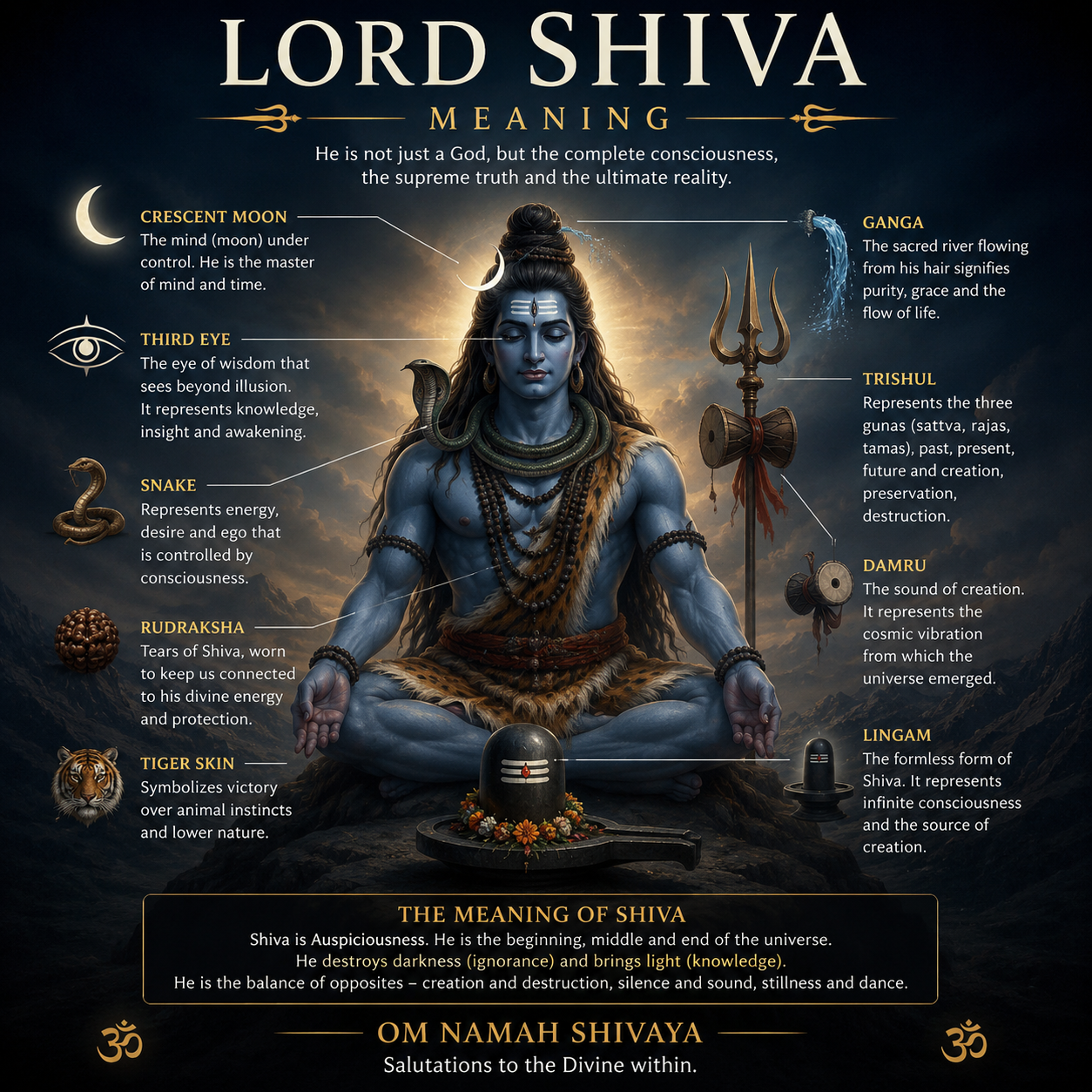
- Eternal Existence – Shiva is infinite, without beginning or end
- Cosmic Consciousness – Union of individual and universal consciousness
- Self-Manifested Form – Not created by humans, appeared naturally
- Divine Light – Shiva’s energy as pure radiance
- Cycle of Creation – Represents creation, preservation, and destruction
The 12 Jyotirlinga Names – Complete Detailed List
There are 12 sacred Jyotirlinga shrines across India. Each has its own unique story, significance, and spiritual power. Let me explain each one in complete detail:
1. Somnath Jyotirlinga (सोमनथ ज्योतिर्लिंग)
Location:
- State: Gujarat
- District: Prabhas Patan, Gir Somnath
- Near: Veraval town, 20 km from Somnath town
- Coast: Arabian Sea coast
Complete Details:
| Aspect | Information |
|---|---|
| Rank | First Jyotirlinga (the most sacred) |
| Significance | Eternal and indestructible nature of Shiva |
| Special Feature | Rebuilt 6 times after invasions – symbol of resilience |
| Temple Name | Somnath Temple (also called Someshwar Temple) |
| River | Near Triveni Sangam (confluence of three rivers) |
| Height | 175 feet tall temple tower |
| Architecture | Nagara style (North Indian temple architecture) |
| Best Time | October–March (avoid monsoon) |
The Legend:
- Somnath = “Lord of the Moon” (Soma = Moon, Nath = Lord)
- According to legend, Moon God (Chandra) was cursed by ** Daksha Prajapati** for favoring one of his 27 wives
- Chandra started fading and losing his glory
- To save himself, Chandra worshipped Lord Shiva at this place
- Shiva blessed Chandra and placed him on his head (shown in Shiva’s iconography)
- This is why Somnath is the first Jyotirlinga – it represents mercy and forgiveness
Historical Significance:
- The temple was destroyed and rebuilt 6 times in history:
- Original temple by Moon God
- Rebuilt by Ravana (demon king from Ramayana)
- Rebuilt by Lord Krishna
- Destroyed by Mahmud of Ghazni (1026 CE)
- Rebuilt by Kumarapala (12th century)
- Destroyed by Aurangzeb (17th century)
- Current temple built by Sardar Patel in 1951 (after independence)
Why Somnath is Special:
- First Jyotirlinga – most important
- Represents eternal and indestructible Shiva
- Symbol of faith and resilience despite invasions
- Located on Arabian Sea – very peaceful setting
- Gateway to Gujarat for pilgrims
2. Mallikarjuna Jyotirlinga (मल्लिकार्जुन ज्योतिर्लिंग)
Location:
- State: Andhra Pradesh
- District: Sri Sathya Sai District (formerly Kurnool)
- Town: Srisailam
- Mountain: Sri Shail mountain (part of Nallamala Hills)
- River: Near Krishna River
Complete Details:
| Aspect | Information |
|---|---|
| Name Variants | Mallikarjuna, Srisailam, Sri Mallikarjuna |
| Significance | Union of Lord Shiva and Goddess Parvati |
| Special Feature | Also one of the 18 Shakti Peethas |
| Temple Name | Sri Mallikarjuna Swamy Temple |
| Altitude | 1,200 feet above sea level |
| Architecture | Dravidian style (South Indian temple architecture) |
| Best Time | October–March (avoid summer heat) |
The Legend:
- Mallikarjuna = “Mallika” (jasmine) + “Arjuna” (white, pure)
- Signifies the union of Lord Shiva and Goddess Parvati
- Goddess Parvati (also called Bhramaramba) is worshipped here
- This is one of the only Jyotirlingas where Shiva and Parvati are worshipped together
- Known as “South Kailash” (दक्षिण का कैलाश) – Himalayan Kailash is in north
Why Mallikarjuna is Special:
- Twin worship – Both Shiva (Mallikarjuna) and Parvati (Bhramaramba)
- 18th Shakti Peetha – one of the 18 most sacred Shakti temples
- Located on mystic mountain with natural temples
- Krishna River flows nearby – very sattvic (pure) environment
- Pilgrimage route connects to many other sacred sites
3. Mahakaleshwar Jyotirlinga (महाकलेश्वर ज्योतिर्लिंग)
Location:
- State: Madhya Pradesh
- District: Ujjain (ancient city)
- River: On Kshipra River banks
- City: Ujjain (one of the 7 most sacred cities in Hinduism)
Complete Details:
| Aspect | Information |
|---|---|
| Name Variants | Mahakaleshwar, Mahakal |
| Significance | Lord of Time and Death – provides moksha |
| Special Feature | Bhasma Aarti (ashes ceremony) at 4 AM |
| Temple Name | Mahakaleshwar Temple |
| Orientation | Downward-facing lingam (unique!) |
| Deity | Bhairava (guardian deity) |
| Best Time | October–March (Kumbh Mela season) |
The Legend:
- Mahakaleshwar = “Mahakal” (great time) + “Ishwar” (Lord)
- Represents Shiva as Lord of Time and Death
- Kshipra River is believed to be goddess Kshipra herself
- When Kshir (milk ocean) was churned, poison emerged
- Shiva drank the poison and saved the world
- This lingam is downward-facing (rare and unique)
Why Mahakaleshwar is Special:
- Bhasma Aarti – only temple where ashes from cremation ground are used
- Downward-facing lingam – unique in all India
- Located in ancient Ujjain (capital of legendary King Vikramaditya)
- Provides moksha (liberation) from cycle of birth and death
- Kumbh Mela held here every 12 years
- 24-hour worship – temple never closes
4. Omkareshwar Jyotirlinga (ओकारेश्वर ज्योतिर्लिंग)
Location:
- State: Madhya Pradesh
- District: Khargone
- Island: Mandhata Island in Narmada River
- River: Narmada River (one of India’s most sacred rivers)
Complete Details:
| Aspect | Information |
|---|---|
| Name Variants | Omkareshwar, Omkar, Mamaleshwar |
| Significance | Shaped like sacred “Om” symbol |
| Special Feature | Two lingams: Omkareshwar and Mamaleshwar |
| Temple Name | Omkareshwar Temple, Mamaleshwar Temple |
| Shape | Island shaped like cosmic “Om” symbol |
| Sacred | One of the 7 Moksha Puris (cities of liberation) |
| Best Time | October–March (after monsoon) |
The Legend:
- Omkareshwar = “Om” (cosmic sound) + “Ishwar” (Lord)
- The island is shaped like the sacred “Om” symbol (ॐ)
- Symbolizes universal consciousness and divine sound
- Two lingams exist on the island:
- Omkareshwar (on west side)
- Mamaleshwar (on east side)
- One lingam, two forms – represents dual nature of existence
Why Omkareshwar is Special:
- Om-shaped island – unique geographical feature
- One lingam, two forms – represents cosmic unity
- Located on Narmada River – most sacred river in India
- Saptam Moksha Puris – one of 7 liberation cities
- Twin worship – both Omkareshwar and Mamaleshwar
- Island setting – very peaceful and meditative
5. Kedarnath Jyotirlinga (केदारनाथ ज्योतिर्लिंग)
Location:
- State: Uttarakhand
- District: Rudraprayag
- Himalayas: Garhwal Himalayas
- Altitude: 11,755 feet (3,583 meters)
- River: Near Mandakini River
Complete Details:
| Aspect | Information |
|---|---|
| Name Variants | Kedarnath, Kedar |
| Significance | Salvation and devotion in Himalayan setting |
| Special Feature | Accessible only May–October (winter closed) |
| Temple Name | Kedarnath Temple |
| Altitude | 11,755 feet – highest Jyotirlinga |
| Trail | 6–7 km trek from Gaurikund |
| Best Time | May–October (summer only) |
The Legend:
- Kedarnath = “Kedar” (field) + “Nath” (Lord)
- Kedar = field of Shiva’s grace
- According to legend, Gods and Pandavas (from Mahabharata) worshipped here
- After Kurukshetra war, Pandavas sought forgiveness
- Shiva appeared as bull and hid in ground
- Only back part of bull emerged – became Kedarnath lingam
- Vakratunda (mountain) emerged where bull’s head was
Why Kedarnath is Special:
- Highest Jyotirlinga – 11,755 feet altitude
- Himalayan setting – most majestic location
- Winter closed – temple closes November–April
- Sacred trek – 6–7 km from Gaurikund
- Pandava connection – from Mahabharata
- Mandakini River flows nearby – very sattvic
- Only open summer – special pilgrimage season
6. Bhimashankar Jyotirlinga (भैमशंकर ज्योतिर्लिंग)
Location:
- State: Maharashtra
- District: Pune
- Hills: Sahyadri hills (Western Ghats)
- River: Near Bhima River
Complete Details:
| Aspect | Information |
|---|---|
| Name Variants | Bhimashankar, Bhima Shankar |
| Significance | Destroyer of evil |
| Special Feature | Lush greenery and natural springs |
| Temple Name | Bhimashankar Temple |
| Distance | 120 miles from Nashik, 100 km from Pune |
| Surroundings | Sahyadri hills – very peaceful |
| Best Time | October–March (after monsoon) |
The Legend:
- Bhimashankar = “Bhima” (strong, powerful) + “Shankar” (Shiva)
- Represents Shiva as destroyer of evil
- Bhima was a powerful demon who terrorized the world
- Shiva killed Bhima and restored peace
- This lingam appeared at the place where Bhima was defeated
Why Bhimashankar is Special:
- Destroyer of evil – removes negativity
- Lush greenery – most beautiful natural setting
- Western Ghats – pristine Himalayan environment
- Bhima River flows nearby – very sacred
- Near Mumbai and Pune – accessible from major cities
- Natural springs – healing waters
- Sahyadri hills – peaceful and meditative
7. Kashi Vishwanath Jyotirlinga (काशी विश्वनाथ ज्योतिर्लिंग)
Location:
- State: Uttar Pradesh
- City: Varanasi (also called Kashi)
- River: On Ganga River (Ganges) banks
- Temple: Kashi Vishwanath Temple (Golden Temple)
Complete Details:
| Aspect | Information |
|---|---|
| Name Variants | Kashi Vishwanath, Vishwanath, Golden Temple |
| Significance | Spiritual capital of India – liberation in life and death |
| Special Feature | Most sacred Hindu site in India |
| Temple Name | Kashi Vishwanath Temple |
| Orientation | Facing east (toward sunrise) |
| River | Ganga River – most sacred river |
| Best Time | October–March (avoid summer heat) |
The Legend:
- Kashi Vishwanath = “Kashi” (Varanasi) + “Vishwanath” (Lord of Universe)
- Varanasi = “Kashi” – oldest living city in the world
- Vishwanath = “Lord of the entire universe”
- Varanasi is considered the spiritual capital of India
- Death here guarantees moksha (liberation)
- Ganga flows here – most sacred river
- Shiva himself promised to give liberation to those who die in Kashi
Why Kashi Vishwanath is Special:
- Most sacred Hindu site in all India
- Oldest living city – 3,000+ years old
- Ganga River banks – most sacred pilgrimage
- Death = moksha – guaranteed liberation
- Vishwanath = Lord of universe (not just one region)
- Golden Temple – most famous Shiva temple
- 24-hour worship – temple never closes
- Millions visit every year
8. Trimbakeshwar Jyotirlinga (त्र्यंबकेश्वर ज्योतिर्लिंग)
Location:
- State: Maharashtra
- District: Nashik
- Town: Trimbakeshwar (also called Trambak)
- River: Near origin of Godavari River
Complete Details:
| Aspect | Information |
|---|---|
| Name Variants | Trimbakeshwar, Trambak, Triambakeshwar |
| Significance | Creation, preservation, destruction |
| Special Feature | Near Godavari River origin |
| Temple Name | Trimbakeshwar Temple |
| River Source | Godavari starts here (1,000 km long) |
| Kumbh Mela | One of 4 places for Kumbh Mela |
| Best Time | October–March (after monsoon) |
The Legend:
- Trimbakeshwar = “Tri” (three) + “Amba” (mother) + “Ishwar” (Lord)
- Represents the three powers: Brahma (creation), Vishnu (preservation), Shiva (destruction)
- Godavari River is considered daughter of Shiva
- River originates at Trimbakeshwar
- Kumbh Mela held here every 12 years (one of 4 places)
Why Trimbakeshwar is Special:
- Three powers – represents creation, preservation, destruction
- Godavari origin – longest river in India starts here
- Kumbh Mela – one of only 4 Kumbh Mela locations
- Ancient temple – over 2,000 years old
- Nashik district – very accessible
- River source – extremely sacred
- Triambakeshwar – full name represents three mothers
9. Vaidyanath Jyotirlinga (वैद्यनाथ ज्योतिर्लिंग)
Location:
- State: Jharkhand
- District: Deoghar
- Town: Deoghar (also called Baba Vaidyanath)
- Near: 150 km from Patna
Complete Details:
| Aspect | Information |
|---|---|
| Name Variants | Vaidyanath, Baba Vaidyanath, Baidyanath |
| Significance | The healer – cures ailments and brings harmony |
| Special Feature | Ravana worshipped here (from Ramayana) |
| Temple Name | Baba Vaidyanath Temple |
| Orientation | 12 directions – represents all directions |
| Best Time | October–March (avoid summer heat) |
The Legend:
- Vaidyanath = “Vaidya” (doctor, physician) + “Nath” (Lord)
- Known as the healer who cures diseases
- Ravana (demon king from Ramayana) worshipped here
- Ravana was a great devotee of Shiva
- Shiva blessed Ravana with knowledge and power
- Cures all ailments – physical, mental, spiritual
Why Vaidyanath is Special:
- The healer – cures diseases and ailments
- Ravana’s temple – from Ramayana
- 12 directions – represents universal protection
- Baba Vaidyanath – most beloved name
- Jharkhand – less visited but very sacred
- Near Patna – accessible from Bihar
- Harmony – brings peace and balance
10. Nageshwar Jyotirlinga (नगेश्वर ज्योतिर्लिंग)
Location:
- State: Gujarat
- District: Dwarka
- Town: Near Dwarka (Lord Krishna’s city)
- Distance: 50 km from Dwarka
Complete Details:
| Aspect | Information |
|---|---|
| Name Variants | Nageshwar, Nagnareshwar |
| Significance | Protection from negativity and evil forces |
| Special Feature | Near Dwarka (Krishna’s city) |
| Temple Name | Nageshwar Temple |
| Naga | Snake – associated with serpent worship |
| Best Time | October–March (avoid summer heat) |
The Legend:
- Nageshwar = “Naga” (snake) + “Ishwar” (Lord)
- Symbolizes protection from negativity and evil forces
- Naga = snake – associated with serpent worship
- Shiva wears snakes around his neck
- Protects devotees from snake bites and negative energies
- Near Dwarka – Lord Krishna’s mythical city
Why Nageshwar is Special:
- Protection – removes negativity and evil
- Snake worship – associated with serpent deities
- Near Dwarka – Krishna’s city
- Gujarat – same state as Somnath
- Serpent power – powerful energy
- Near Krishna temple – dual worship possible
11. Rameshwaram Jyotirlinga (रामेश्वरम ज्योतिर्लिंग)
Location:
- State: Tamil Nadu
- Island: Pamban Island (Rameswaram)
- Distance: 1,000 km from Chennai
- Coast: Bay of Bengal coast
Complete Details:
| Aspect | Information |
|---|---|
| Name Variants | Rameshwaram, Ramanathaswamy, Sri Ramanathaswamy |
| Significance | Associated with Ramayana – Lord Rama worshipped here |
| Special Feature | Southmost Jyotirlinga |
| Temple Name | Sri Ramanathaswamy Temple |
| Story | Rama worshipped Shiva after war with Ravana |
| Char Dham | One of the 4 Char Dham pilgrimage sites |
| Best Time | October–March (avoid monsoon) |
The Legend:
- Rameshwaram = “Rama” (Lord Rama) + “Ishwaram” (Lord)
- Associated with Ramayana
- After war with Ravana, Lord Rama felt guilty
- Rama wanted to purify himself and seek forgiveness
- Rama built a Shiva lingam with help of Hanuman and monkey army
- This lingam is now the Rameshwaram Jyotirlinga
- Hanuman helped build the bridge (Ram Setu) to Lanka
Why Rameshwaram is Special:
- Ramayana connection – from greatest Hindu epic
- Southmost Jyotirlinga – last in southern India
- Char Dham – one of 4 most sacred pilgrimage sites
- Rama’s temple – Lord Rama worshipped here
- Hanuman connection – great devotee of Rama
- Pamban Island – mystical island setting
- Bay of Bengal – coastal pilgrimage
12. Grishneshwar Jyotirlinga (ग्रीष्णेश्वर ज्योतिर्लिंग)
Location:
- State: Maharashtra
- District: Aurangabad
- Town: Ellora (near Ellora Caves)
- Distance: 12 km from Daulatabad station
Complete Details:
| Aspect | Information |
|---|---|
| Name Variants | Grishneshwar, Ghushmeshwar, Shri Ghushmeshwar |
| Significance | Faith and simplicity |
| Special Feature | Smallest Jyotirlinga temple |
| Temple Name | Grishneshwar Temple |
| Nearby | Ellora Caves (UNESCO World Heritage Site) |
| Best Time | October–March (after monsoon) |
The Legend:
- Grishneshwar = “Ghushma” (devotee) + “Ishwar” (Lord)
- Ghushma was a devoted woman who worshipped Shiva
- Her son died, but she never lost faith
- Shiva blessed her and brought her son back to life
- This lingam represents faith and simplicity
- Named after Ghushma’s devotion
Why Grishneshwar is Special:
- Smallest temple – most humble and simple
- Faith and simplicity – represents pure devotion
- Near Ellora Caves – UNESCO World Heritage Site
- Ghushma’s story – ultimate devotion
- Aurangabad – accessible from major cities
- UNESCO site nearby – cultural pilgrimage
- Maharashtra – 3rd Jyotirlinga in this state
Complete Significance of All 12 Jyotirlingas
What Each Jyotirlinga Represents:
| Jyotirlinga | Primary Significance |
|---|---|
| Somnath | Eternal, indestructible Shiva (first) |
| Mallikarjuna | Union of Shiva and Parvati |
| Mahakaleshwar | Lord of time and death (moksha) |
| Omkareshwar | Universal consciousness (Om symbol) |
| Kedarnath | Salvation and devotion (Himalayas) |
| Bhimashankar | Destroyer of evil |
| Kashi Vishwanath | Spiritual capital (moksha guaranteed) |
| Trimbakeshwar | Creation, preservation, destruction |
| Vaidyanath | The healer (cures ailments) |
| Nageshwar | Protection from negativity |
| Rameshwaram | Ramayana connection (Rama’s worship) |
| Grishneshwar | Faith and simplicity |
Benefits of Visiting Jyotirlingas:
- Moksha – Liberation from cycle of birth and death
- Peace – Inner tranquility and spiritual calm
- Prosperity – Material and spiritual wealth
- Removal of obstacles – Problems and negativity cleared
- Curing diseases – Physical and mental healing
- Fulfillment of desires – Wishes granted
- Spiritual elevation – Higher consciousness
- Forgiveness – Past sins washed away
- Protection – From evil forces and negativity
- Inner transformation – Personal growth
State-wise Distribution Summary
| State | Number | Jyotirlingas |
|---|---|---|
| Maharashtra | 3 | Bhimashankar, Trimbakeshwar, Grishneshwar |
| Gujarat | 2 | Somnath, Nageshwar |
| Madhya Pradesh | 2 | Mahakaleshwar, Omkareshwar |
| Uttarakhand | 1 | Kedarnath |
| Uttar Pradesh | 1 | Kashi Vishwanath |
| Andhra Pradesh | 1 | Mallikarjuna |
| Jharkhand | 1 | Vaidyanath |
| Tamil Nadu | 1 | Rameshwaram |
Total: 12 Jyotirlingas across 8 states of India
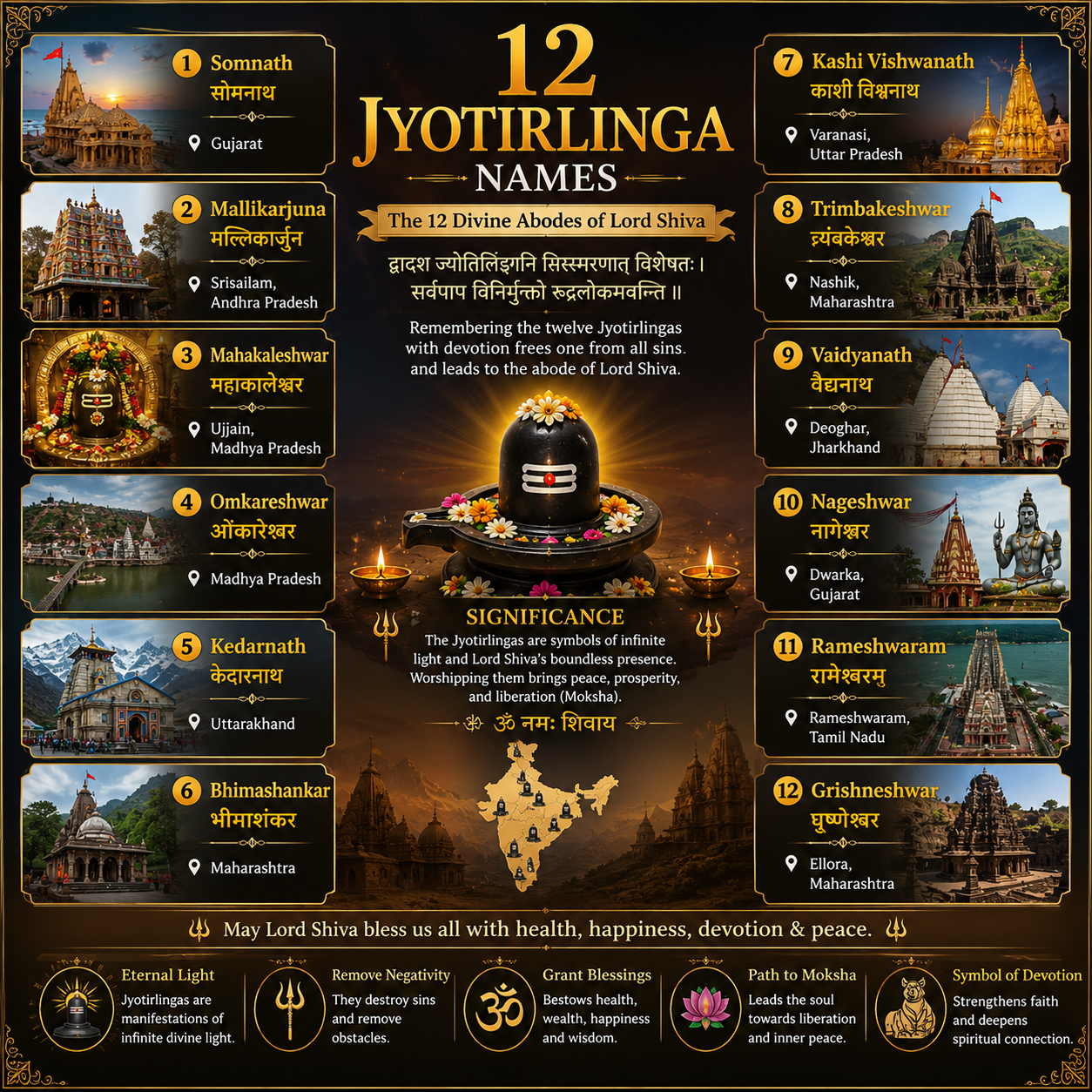
All 12 Names
1. Somnath (Gujarat)
2. Mallikarjuna (Andhra Pradesh)
3. Mahakaleshwar (Madhya Pradesh)
4. Omkareshwar (Madhya Pradesh)
5. Kedarnath (Uttarakhand)
6. Bhimashankar (Maharashtra)
7. Kashi Vishwanath (Uttar Pradesh)
8. Trimbakeshwar (Maharashtra)
9. Vaidyanath (Jharkhand)
10. Nageshwar (Gujarat)
11. Rameshwaram (Tamil Nadu)
12. Grishneshwar (Maharashtra)