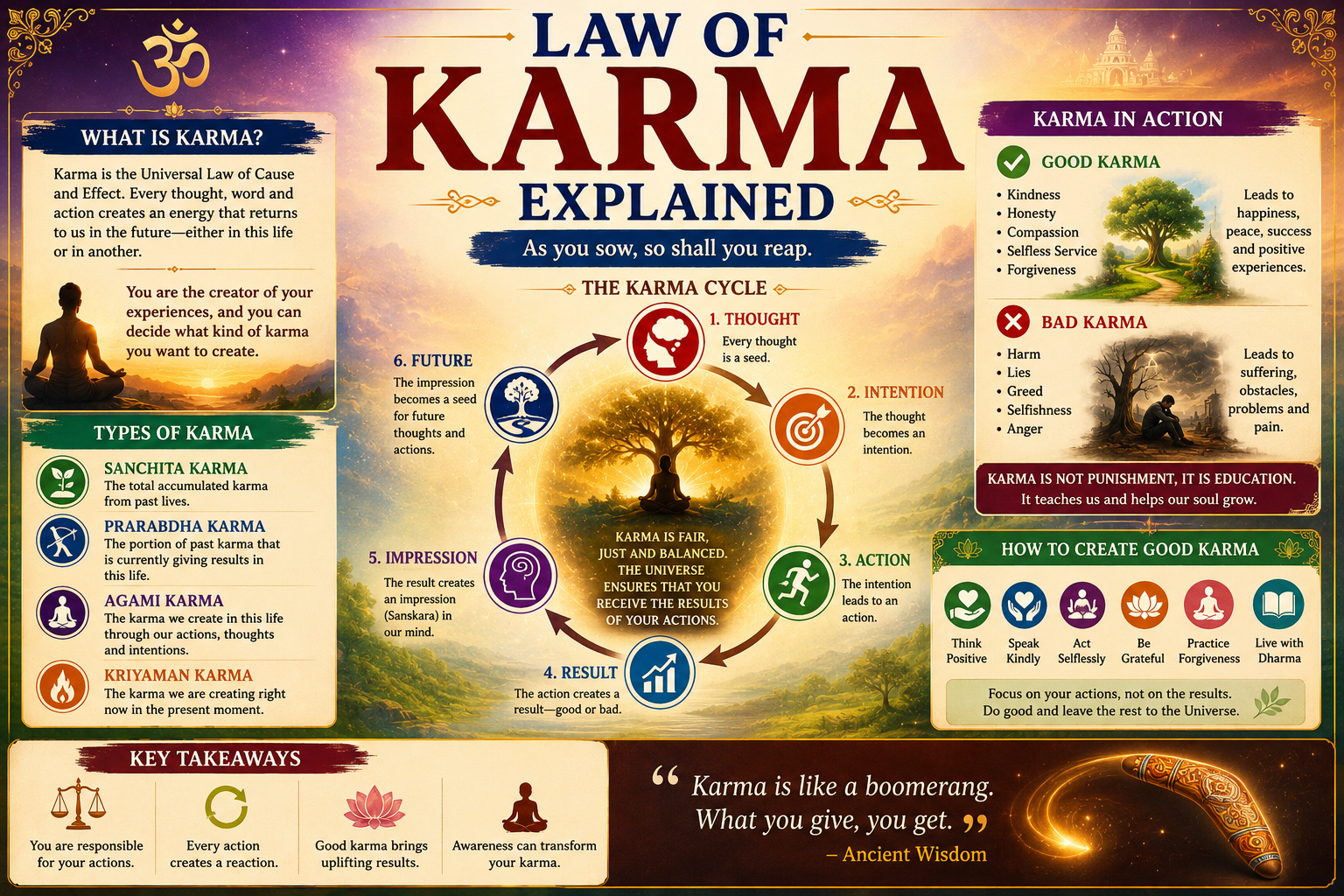
The Law of Karma is one of the most widely discussed and deeply meaningful ideas in Hindu philosophy and many other spiritual traditions. At its simplest, karma means action and the results that follow from that action. It teaches that every thought, word, and deed creates an effect, and that nothing we do is completely without consequence. This makes karma both a moral principle and a spiritual law.
For beginners, karma is often misunderstood as fate or punishment. In reality, it is closer to the idea of cause and effect. Good actions tend to produce helpful results, while harmful actions often bring difficulty or suffering. Karma is not meant to scare people; instead, it encourages awareness, responsibility, and ethical living. It reminds us that our choices matter.
The law of karma is not only about what happens after death. It also works in everyday life. The way we treat others, the habits we build, the emotions we hold, and the intentions behind our actions all shape the quality of our present and future experiences. In this sense, karma is both immediate and long-term.
Meaning of Karma
The word karma comes from Sanskrit and means action, work, or deed. In spiritual thought, karma refers not just to physical action but also to thoughts, intentions, and speech. This is important because a person’s inner state also influences their life.
If someone acts with kindness, honesty, and self-control, those qualities create positive momentum in life. If someone acts with greed, cruelty, or dishonesty, those actions create negative effects. Karma therefore links morality with results.
Karma is not random. It is based on the idea that the universe is morally structured. Actions create impressions, and those impressions shape future experiences. This gives human life a sense of responsibility and meaning.
How Karma works
The law of karma works through cause and effect. Every action produces an outcome, though the result may not always be immediate. Sometimes the effect appears quickly, and sometimes it appears much later. This delay is one reason karma can be difficult to understand.
Actions do not only create outer results; they also shape the mind and personality. Repeated habits become part of a person’s character. A person who constantly practices patience becomes more peaceful, while a person who repeatedly acts in anger may become more disturbed. In this way, karma influences both external life and inner life.
Some traditions explain karma as forming invisible impressions in the mind or soul. These impressions may stay with a person and influence future situations. Whether understood literally or symbolically, the main lesson is clear: actions have lasting power.
Intention and action
One of the most important parts of karma is intention. Two people may perform the same action, but if their intentions are different, the karmic effect may also be different. A kind act done sincerely has a different spiritual value from a kind act done to gain praise.
This is why Hindu philosophy emphasizes not only what we do, but why we do it. Pure intention is considered very important because it shapes the moral quality of action. A good heart can elevate an action, while selfish motives can weaken it.
This teaches people to examine themselves honestly. Before acting, one should ask: Is this truthful? Is this helpful? Is this rooted in compassion or ego? Such reflection makes karma a practical tool for self-growth.
Types of karma
In Hindu philosophy, karma is often discussed in different forms. One common explanation divides karma into three types.
Sanchita karma
This refers to the total store of past karma accumulated over many lives. It is like a reserve of karmic impressions that have not yet been fully experienced.
Prarabdha karma
This is the part of karma that is already active in the present life. It is the portion of past actions that is now unfolding as present circumstances.
Kriyamana karma
This refers to the karma a person creates now through current thoughts, words, and actions. It is the karma being formed in the present moment.
These categories help explain why life is so complex. Some things we experience may come from past causes, while many others are created by our present choices. This understanding gives both humility and hope.
Karma and rebirth
The law of karma is closely linked with rebirth, also known as samsara. Hindu philosophy teaches that the soul continues its journey through many lives. The karma created in one life influences the conditions of future lives.
This does not mean a person is trapped without possibility. Rather, it means the soul has a long journey of learning and growth. Each life offers opportunities to evolve spiritually and morally. Karma is the force that shapes this journey.
The connection between karma and rebirth also explains why life appears uneven. People are born into different situations, with different strengths and difficulties. In karmic thought, these differences are not meaningless accidents but part of a larger spiritual process.
Karma and dharma
Karma and dharma are closely related. Dharma means duty, righteousness, and the right way to live. Karma is the action that follows from those choices. When a person follows dharma, they create better karma.
This relationship makes ethics central to spiritual life. It is not enough to believe in good ideas. One must live them through honest, responsible, and compassionate action. Dharma guides the path, and karma shows the result.
In practical terms, this means that living rightly is not only good for society, but also good for one’s own spiritual development. The law of karma encourages people to act in a way that supports harmony.
Karma in daily life
The law of karma is not limited to religious rituals or philosophical debate. It operates in everyday life. How we speak to family, how we treat strangers, how we work, how we respond to difficulty—all of these create karma.
For example, if someone lies often, trust may weaken in their relationships. If someone is generous and thoughtful, trust and goodwill may grow around them. These results can be seen in ordinary life even without using spiritual language.
This makes karma a very practical teaching. It reminds us that every small act matters. No action is truly insignificant because it contributes to the kind of life we are creating.
Karma and suffering
Many people ask why bad things happen to good people. Karma is often used to answer this question, though carefully. Hindu thought does not always say that suffering is simple punishment. Sometimes suffering may be the result of past causes, and sometimes it may be part of growth, learning, or purification.
This is important because karma is not a quick moral scoreboard. It is a deep spiritual law, not a simple reward-and-punishment system. People may go through hardship for reasons that are not immediately visible.
At the same time, karma also encourages compassion. If suffering is part of a larger moral process, then one should respond to others with kindness rather than judgment. No one fully sees another person’s karmic journey.
Karma and freedom
The law of karma does not mean that human beings are completely helpless. In fact, it gives responsibility and freedom. Since our actions shape our future, we are not merely victims of destiny. We can choose differently and create better outcomes.
This is one of the most empowering parts of karma. Even if a person has past burdens, present choices still matter. A new action can begin a new direction. This means change is always possible.
Spiritual practice, self-awareness, prayer, service, and discipline are all ways of transforming karma. The goal is not to escape responsibility but to live more wisely so that the mind becomes freer and the soul moves closer to liberation.
Karma in other traditions
Although karma is strongly associated with Hinduism, similar ideas appear in other traditions too. Buddhism, Jainism, and some modern spiritual systems also speak about action and consequence. This shows that the principle is widely recognized as meaningful.
Different traditions may explain karma in different ways, but the core idea remains similar: what we do affects who we become and what we experience. This universality is one reason karma continues to attract interest around the world.
Because the idea is so broad, people sometimes use the word casually. But in its deepest sense, karma is not just a popular saying. It is a serious moral and spiritual teaching.
Common misunderstandings
One common misunderstanding is that karma means everything is predestined. This is not correct. Karma teaches that our actions matter and that we can shape our future through present choices. It is not a denial of freedom.
Another misunderstanding is that karma only works as punishment. In reality, karma is not simply negative. Good actions bring good results, and spiritual progress is also part of karmic development.
A third misunderstanding is that if something good or bad happens, we can immediately explain it by karma. This can be harmful and simplistic. Human life is too complex for easy judgments. Karma should be understood with humility, not arrogance.
Karma and spiritual growth
Karma is deeply connected with the path of spiritual growth. As a person becomes more aware, they begin to act with greater clarity. They learn to reduce selfishness and increase compassion. This changes both outer life and inner state.
In many spiritual traditions, the purpose of karma is not just to explain life but to help purify it. When actions become more selfless, the mind becomes lighter. When the mind becomes lighter, deeper peace becomes possible.
This is why karma is often taught alongside meditation, devotion, and self-discipline. These practices help a person move beyond mechanical action toward conscious living.
Why karma matters
Karma matters because it gives moral seriousness to life. It says that our choices are not empty. Words can heal or harm. Actions can build or destroy. Habits can liberate or bind. This understanding makes life more meaningful.
It also matters because it encourages responsibility without despair. Even if the past cannot be changed, the present still can. That gives human beings real dignity and hope.
In this way, karma is both a warning and a gift. It warns us that actions have consequences, and it gifts us the power to choose better.
Conclusion
The Law of Karma is the principle that every action creates an effect. It teaches that life is shaped by our thoughts, words, intentions, and deeds. It is closely connected with dharma, rebirth, spiritual growth, and liberation.For beginners, the simplest way to understand karma is this: what you do matters, how you do it matters, and why you do it matters. Karma is not just about fate; it is about responsibility, awareness, and the opportunity to grow.By living with honesty, compassion, discipline, and mindfulness, a person can create better karma and move toward a more peaceful and meaningful life. That is the heart of the Law of Karma.