Introduction
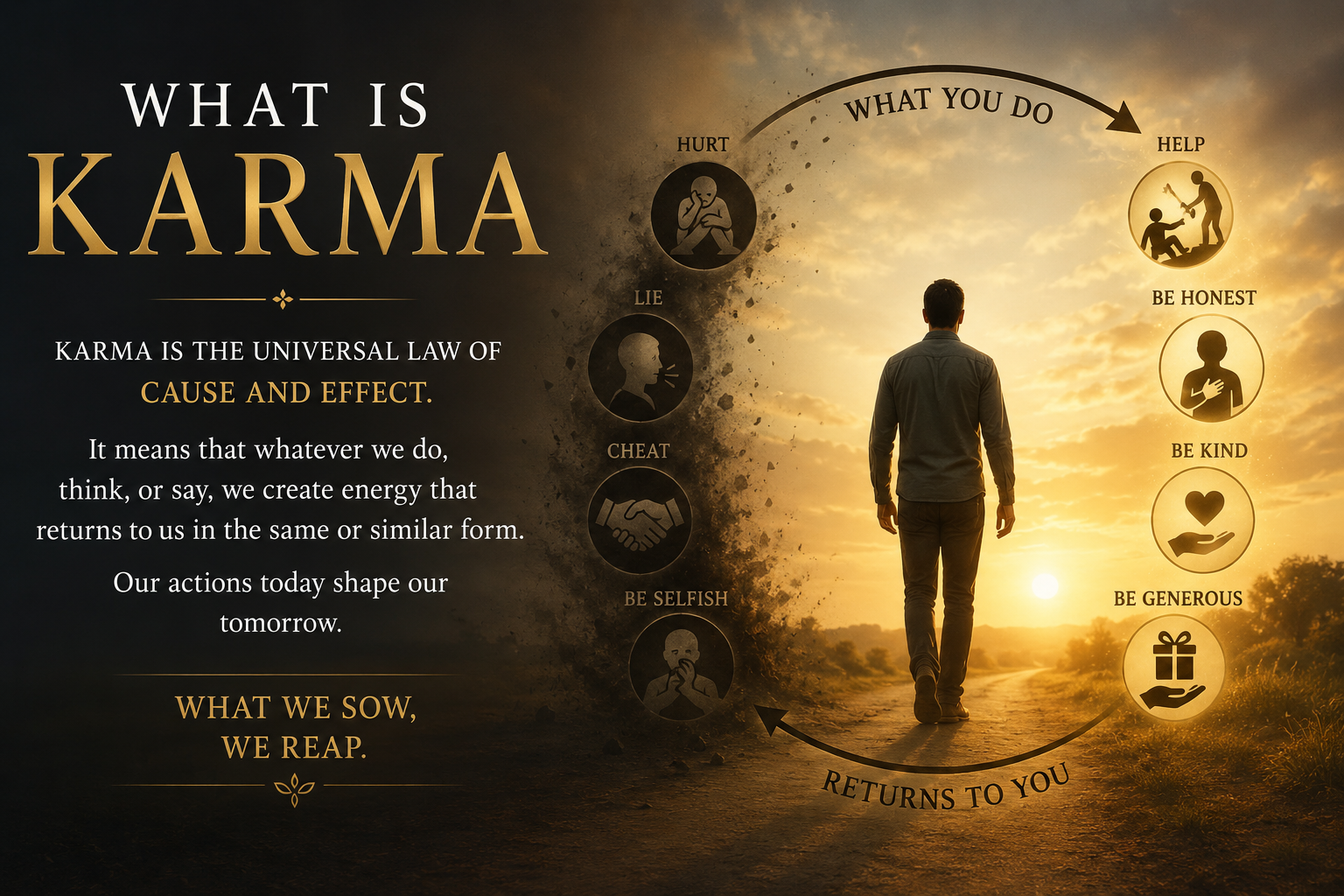
Karma is one of the most profound and enduring concepts in Indian philosophy, central to Hinduism, Buddhism, Sikhism, and Jainism. It’s a Sanskrit word that literally translates to “action“, but its meaning goes far deeper than just physical deeds. Karma represents the universal principle of cause and effect—the understanding that every action we take, whether through thought, word, or deed, generates consequences that will inevitably return to us.
The phrase “what goes around comes around” perfectly captures karma’s essence. This principle teaches that we are not passive victims of fate but active creators of our own destiny through our choices and behaviors.
The Literal Meaning and Etymology
Karma (कर्म) comes from the Sanskrit root word kárman, meaning “act,” “action,” or “performance”. The word was first attested in English in 1785 in a translation of the Bhagavad Gita by Charles Wilkins.
In its most basic sense, karma simply means action. However, in Hindu and Buddhist philosophy, it evolved to describe the moral quality of actions and their inevitable consequences.
The Core Principle: Cause and Effect
How Karma Works
Karma operates as a fundamental law of nature, similar to how gravity works. When you perform an action:
- Thought creates intention — Every action begins with a thought or intention
- Intention drives action — This intention manifests as physical, verbal, or mental action
- Action creates impressions — The action leaves an imprint or impression on your consciousness
- Impressions generate consequences — These impressions eventually manifest as experiences in your life
The key insight is that karma is not just about physical actions. Thoughts, feelings, and intentions all create karmic impressions. Even unexpressed thoughts can generate karma if they carry strong emotional intensity.
Moral Quality Matters
Karma is not neutral—it carries a moral quality:
- Good karma arises from actions rooted in compassion, kindness, truth, and selflessness
- Bad karma arises from actions rooted in greed, hatred, deception, and selfishness
- The intention behind the action determines whether it creates good or bad karma
This is why two people performing the same physical action can generate completely different karmic results. A doctor giving medicine with genuine compassion creates good karma; the same doctor giving medicine motivated by greed creates negative karma.
The Work of Karma: Three Types
According to spiritual teacher Gurudev Sri Sri Ravi Shankar, karma operates through three distinct categories:
1. Sanchita Karma (Accumulated Karma)
Sanchita means “accumulated” or “stored.” This is the total sum of all karmas from all past lives that you have accumulated but not yet experienced.
- Think of it as a vast warehouse storing every action from your previous existences
- It represents the potential for future experiences
- Sanchita karma is not fixed—it can be nullified through awareness, spiritual practice, and right action
2. Prarabdha Karma (Manifested Karma)
Prarabdha means “manifested” or “destined.” This is the portion of your sanchita karma that has been selected to be experienced in this particular life.
- This is your current life’s destiny—what you must experience
- It includes your birth circumstances, family, health challenges, major life events
- Prarabdha karma must be experienced—you cannot escape it
- However, your response to it (with awareness or ignorance) determines whether you create new karma
3. Agami Karma (Future Karma)
Agami means “coming” or “future.” This is the karma you are creating right now through your current actions.
- Every action you take today becomes agami karma
- It will manifest as experiences in your future lives or later in this life
- Agami karma is entirely within your control—you choose what to create
- Through awareness and right action, you can prevent agami karma from binding you
Key Mechanisms of Karma
Intention and Awareness
The most crucial insight about karma is that impressions of actions, not just actions themselves, create karmic bondage. This means:
- Awareness breaks bondage: When you act with full awareness, like a witness observing your actions, you don’t accumulate karma
- Identification creates bondage: When your intellect identifies with the action (“I am doing this”), karma binds you
- Enlightened action: Like a mirror that reflects but never holds on, an enlightened person acts without accumulating karma
The Mirror Analogy
Gurudev explains karma using the metaphor of a mirror free of impressions:
“Like a mirror free of impressions, an enlightened person acts without accumulating karma”
A mirror reflects everything perfectly but holds nothing. Similarly, when you act as a witness rather than an identifier, you remain free from karmic consequences.
Grace and Free Will
Karma is not fatalism. Important factors include:
- Grace plays a role: Divine grace can help transcend karmic patterns
- Free will exists: You are not trapped—you can choose how to respond to prarabdha karma
- The way of karma is vast: The process is unfathomable and complex, not simple cause-and-effect
Karma Across Different Traditions
In Hinduism
In Hindu philosophy, karma is connected to:
- The cycle of rebirth (samsara) — Your karma determines your next incarnation
- The soul’s journey — Each life is an opportunity to resolve past karma
- Duty (dharma) — Performing your duty without attachment creates good karma
- Moksha (liberation) — Breaking free from the karmic cycle through spiritual realization
Hinduism emphasizes that each individual is born with karma, the residual from past lives that must be resolved.
In Buddhism
Buddhism views karma slightly differently:
- No permanent soul: Karma operates without a fixed “self”
- Moment-to-moment: Every moment creates new karma
- Compassion central: Actions rooted in compassion and wisdom create positive karma
- Nirvana: The goal is to transcend karma entirely through enlightenment
The Buddhist concept emphasizes that “performing kind acts in this life gives you good karma for your next life“.
Common Understanding
Across traditions, the universal teaching is:
Performing kind acts creates good karma; harmful acts create bad karma. This applies to all beings, regardless of religious affiliation.
Practical Examples of Karma
Everyday Life Examples
- Helping someone in need
- Action: Giving money to a hungry person
- Intention: Compassion and generosity
- Result: Good karma — you’ll experience help when you need it
- Lying to avoid consequences
- Action: Deceiving your boss about your work
- Intention: Self-preservation through dishonesty
- Result: Bad karma — deception will be used against you later
- Speaking truth with kindness
- Action: Giving honest feedback gently
- Intention: Helping someone grow
- Result: Good karma — others will trust your guidance
Long-Term Karma Examples
- Throughout childhood, you bully others
- Accumulated karma: Deep negative impressions
- Manifested result: In adulthood, you face isolation and rejection
- You consistently mentor and support young people
- Accumulated karma: Positive impressions of generosity
- Manifested result: Others support you when you’re in need
Common Misconceptions About Karma
Misconception 1: “Karma is Punishment”
Reality: Karma is not punishment—it’s a natural law. Just as gravity isn’t punishing you when you fall, karma isn’t punishing you for past actions. It’s simply the inevitable consequence of what you created.
Misconception 2: “Karma is Immediate”
Reality: Karma can take time to manifest. Sometimes good actions create immediate results; sometimes they take years or decades. The timing is complex and depends on many factors.
Misconception 3: “Bad Things Happen to Bad People”
Reality: Sometimes good things happen to people who seem to do bad things. This is because:
- They may be experiencing good karma from past lives
- Grace and luck play roles
- Karma operates across lifetimes, not just within one life
Misconception 4: “Karma is Fatalism”
Reality: Karma is not fatalistic. You have free will to:
- Choose how to respond to your prarabdha karma
- Create new agami karma through awareness
- Nullify sanchita and agami karma through spiritual practice
How to Work With Karma
1. Cultivate Awareness
The most powerful way to transcend karmic bondage is through awareness:
- Practice observing your thoughts without identifying with them
- Act as a witness to your actions
- Develop mindfulness in daily activities
2. Practice Right Action
- Perform actions with compassion and selflessness
- Avoid actions rooted in greed, hatred, or deception
- Let your intention be pure, not just the outcome
3. Develop Spiritual Practice
According to Gurudev, sanchita and agami karma can be nullified through awareness and right action:
- Meditation
- Prayer
- Service to others
- Study of spiritual texts
4. Accept What You Cannot Change
Prarabdha karma must be experienced. Instead of resisting:
- Accept your circumstances with awareness
- Respond with compassion rather than anger
- Use challenges as opportunities for growth
Karma and Modern Science
Modern psychology and neuroscience are beginning to understand aspects of karma:
- Behavioral patterns: Our actions create habits that shape our future behavior
- Neuroplasticity: Thoughts and actions physically change our brains
- Reciprocity: Research shows people who help others receive help in return
- Mindfulness: Awareness practices reduce stress and improve decision-making
Gurudev explains that “modern science” is beginning to confirm ancient wisdom about karma and impressions.
Karma in Literature and Culture
The Short Story “Karma” by Khushwant Singh
There’s a famous short story titled “Karma” written by Indian writer Khushwant Singh, published in 1989. The story is about:
- An Oxford-educated Indian man who adopts upper-class English culture
- He expects to be accepted by British colonial officers
- Instead, he’s rejected, showing that trying to be someone you’re not creates negative karma
This story illustrates karma’s principle: actions motivated by false identity and self-deception lead to negative consequences.
Everyday Language
Today, people commonly say:
- “Karma!” — when someone experiences consequences for their actions
- “What goes around comes around” — describing karma’s principle
- “Good karma” — positive energy or fortune
- “Bad karma” — negative energy or trouble
The Ultimate Goal: Transcending Karma
In both Hinduism and Buddhism, the ultimate spiritual goal is to transcend the karmic cycle:
In Hinduism: Moksha (Liberation)
- Breaking free from samsara (cycle of rebirth)
- Realizing your true nature as the eternal soul
- No longer accumulating new karma
In Buddhism: Nirvana
- Ending the cycle of suffering and rebirth
- Realizing the emptiness of self
- Acting without attachment to results
How to Transcend
The key is acting without identification:
“When you act like a witness, you remain free—like a mirror that reflects but never holds on”
Conclusion
Karma is not a simple formula of “good deeds = good rewards.” It’s a vast, complex, and unfathomable process that spans lifetimes. The principle teaches us that:
- We are responsible for our circumstances through our past and present actions
- Intention matters more than the physical action itself
- Awareness frees us from karmic bondage
- Free will exists—we can choose how to respond and what to create
- Grace plays a role—divine help can transcend karmic patterns
Understanding karma empowers us to live more consciously, make better choices, and ultimately transcend the cycle of cause and effect. As the saying goes: “Performing kind acts in this life gives you good karma for the next life“.
The work of karma is to ensure that every being experiences the consequences of their actions, creating a universe of moral order and ultimate justice. Through awareness, compassion, and right action, we can transform our karma and create a better future for ourselves and others.