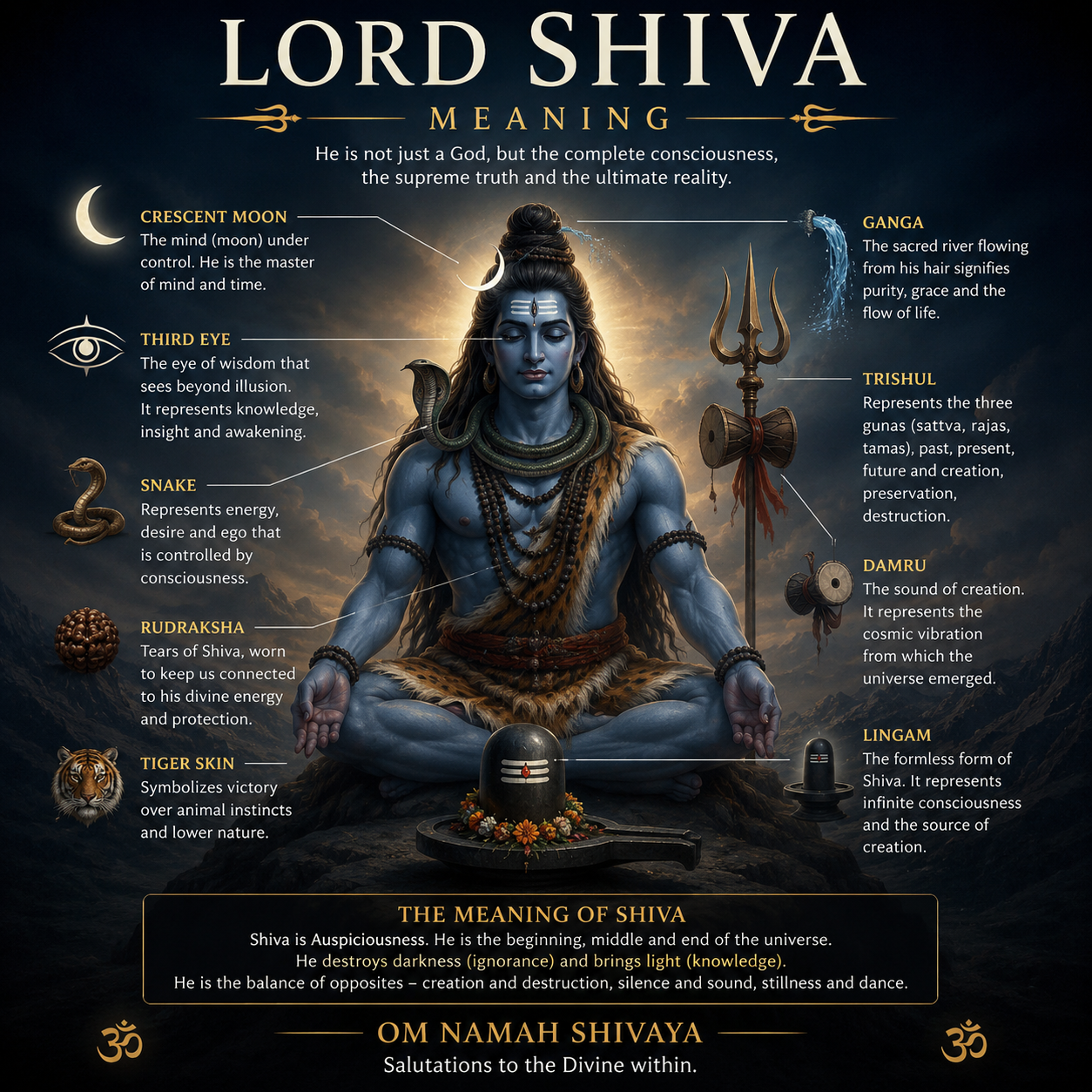
Lord Shiva is one of the principal deities in Hinduism, revered as the supreme ascetic, the cosmic dancer, and the compassionate destroyer of ignorance. Shiva’s name and attributes weave together deep philosophical ideas, spiritual practices, and rich cultural symbolism that have inspired devotees, poets, and philosophers for millennia.
Meaning and Names
- Shiva literally means “auspicious,” “benevolent,” or “the pure one.” The word suggests a force that brings welfare and transformation.
- Shiva is known by many names—Mahadeva (Great God), Shankar (the benevolent), Bholenath (innocent lord), Rudra (the roaring one), and Nataraja (lord of the dance)—each reflecting a different facet of his nature.
Core Aspects and Symbolism
- The Destroyer and Transformer: In the Trimurti (Brahma the creator, Vishnu the preserver, Shiva the destroyer), Shiva’s role is not merely destructive in a negative sense. He dissolves forms and illusions so that renewal and transformation can occur. This cyclical vision of life, death, and rebirth is central to Hindu thought.
- The Ascetic Yogi: Shiva is often depicted in deep meditation, seated on Mount Kailash, embodying detachment, discipline, and mastery over the senses. He is the ideal of renunciation and inner stillness.
- The Householder: Paradoxically, Shiva is also a devoted family man—husband of Parvati and father to Ganesha and Kartikeya—symbolizing balance between worldly responsibilities and spiritual pursuit.
- Nataraja, the Cosmic Dancer: As Nataraja, Shiva’s tandava (dance) symbolizes the cosmic cycles of creation, preservation, and destruction. The dance combines grace and power, illustrating the rhythm of existence.
- The Lingam: The Shiva Lingam, an abstract pillar-like symbol, represents the formless aspect of divinity, the union of creation and dissolution, and the infinite nature of cosmic consciousness.
- Third Eye: Shiva’s third eye symbolizes higher perception, inner vision, and the power to destroy ignorance. When opened, it dissolves illusions and reveals truth.
- Blue Throat (Neelkanth): After consuming poison to save the universe during the churning of the ocean (Samudra Manthan), Shiva held the poison in his throat, which turned blue—symbolizing his sacrifice for the welfare of all beings.
- Trident (Trishula): The trident represents Shiva’s power over the three worlds, the three gunas (qualities), and the three aspects of time—past, present, and future.
- Ashes and Rudraksha: Shiva’s body smeared with ashes (vibhuti) signifies the transient nature of the physical world. Rudraksha beads, associated with his tears, symbolize spiritual protection and concentration.
Philosophical Significance
- Non-dual and Devotional Paths: Shiva is central to both Advaita (non-dual) philosophies and bhakti (devotional) traditions. Shaivism offers diverse schools—from meditative, knowledge-driven approaches to passionate devotional practices—allowing seekers to approach the divine through multiple paths.
- Liberation (Moksha): Shiva represents the possibility of liberation from suffering and the cycle of rebirth. Through surrender, meditation, or inner transformation, devotees seek release (moksha) and union with the supreme consciousness.
Cultural Influence
- Festivals: Maha Shivaratri, the “great night of Shiva,” is celebrated with fasting, night-long vigils, prayers, and chanting. Devotees honor Shiva’s power to awaken spiritual insight.
- Art and Architecture: Temples, sculptures (especially the dancing Nataraja), and classical dances draw heavily from Shiva’s imagery. His iconography influences Indian music, dance, literature, and visual arts.
- Contemporary Relevance: Today, Shiva’s image—ascetic yet compassionate, fierce yet tender—resonates with people seeking inner balance, resilience, and authentic transformation.
Conclusion
Lord Shiva symbolizes the profound interplay of destruction and renewal, inner stillness and dynamic energy. Whether viewed as a cosmic dancer, a meditative sage, a compassionate protector, or the formless absolute, Shiva invites seekers to confront change, dissolve ego, and recognize the timeless essence within.