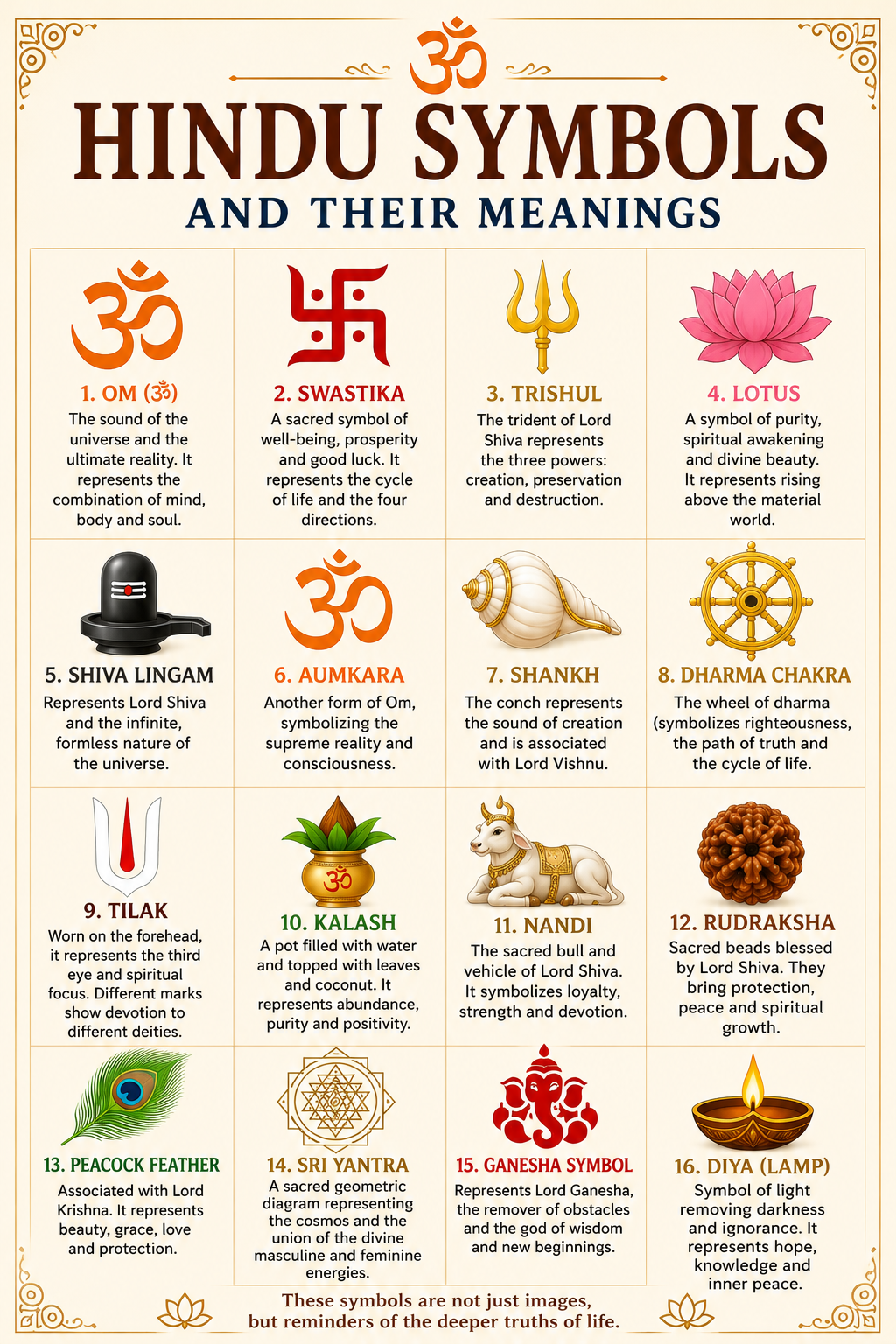
Hindu symbols are powerful visual expressions of spiritual ideas, divine qualities, and cultural identity. They are found in temples, homes, religious books, rituals, festivals, art, jewelry, clothing, and even everyday worship. For many Hindus, symbols are not just decorations. They are meaningful signs that help people remember divine truths, connect with sacred traditions, and focus the mind on spiritual values. A single symbol can carry centuries of faith, philosophy, and devotion.
Hinduism is a very ancient and diverse tradition, and its symbols reflect that richness. Some symbols represent God in a formless way, while others represent divine powers, sacred principles, or moral qualities. Some are used in worship, some in meditation, and some in social or cultural life. Together, they create a visual language that helps explain ideas that are often too deep or abstract to express only in words.
For beginners, Hindu symbols may seem simple at first, but each one has a deeper meaning. The sacred syllable Om, the Swastika, the lotus, the Trishul, the conch shell, the tilak, the diya, and many other signs all have unique roles in Hindu life. Understanding them gives a clearer view of what Hinduism values: truth, purity, devotion, strength, balance, wisdom, and liberation.
Why symbols matter in Hinduism
Symbols are important in Hinduism because they help transform invisible spiritual ideas into forms that the eye and mind can understand. Human beings often learn through images and gestures, so symbols become a natural bridge between outer life and inner truth. When a devotee sees a symbol, it can remind them of a deity, a teaching, a prayer, or a sacred duty.
In Hindu practice, symbols are not empty marks. They are living reminders of spiritual presence. A symbol can become part of daily prayer, temple worship, meditation, or celebration. It can also unite communities by giving them a shared language of faith.
This is one reason Hindu symbolism is so rich. It supports both devotion and philosophy. It can be simple enough for a child to recognize, yet deep enough for a scholar to study for years. That balance is one of the beautiful features of Hindu religious culture.
Om
Om is perhaps the most famous Hindu symbol and sound. It is often considered the primordial vibration from which creation emerged. In Hindu thought, Om is not only a sacred sound but also a representation of the deepest reality. It appears in prayers, meditation, scriptures, and temple rituals.
The symbol of Om is written in a stylized form that is instantly recognizable. It is often placed at the beginning of sacred texts and chanted before prayer or meditation. The sound is believed to calm the mind and help the person focus on the divine.
Om is also associated with the three major states of consciousness: waking, dreaming, and deep sleep. Some interpretations connect it with the divine triad of creation, preservation, and dissolution. Because of these layers of meaning, Om is not just a symbol of Hindu identity but also a symbol of universal spiritual truth.
Swastika
The Swastika is one of the oldest and most important symbols in Hinduism. In its traditional form, it is a sign of auspiciousness, well-being, good fortune, and spiritual harmony. It is commonly drawn on doors, prayer spaces, temples, and festival decorations.
The symbol is used in many ceremonies because it represents blessings and positive energy. Its arms often suggest movement, balance, and the flow of life. In Hindu tradition, it is a sacred and protective symbol that invites prosperity and harmony.
It is important to understand the original meaning of the Swastika in Hinduism and other Indian traditions. It is an ancient sacred symbol of good fortune and has nothing to do with later negative historical uses in the modern world. In Hindu life, it remains a respected mark of auspiciousness.
Lotus
The lotus flower is a very important Hindu symbol. It represents purity, beauty, spiritual growth, and detachment. The lotus grows in muddy water, yet it rises above the surface and blooms beautifully without being stained by the dirt around it. This makes it a powerful symbol of how a person can live in the world without becoming spiritually polluted by it.
Many Hindu deities are shown sitting on a lotus or holding one. Lakshmi, the goddess of wealth and prosperity, is closely associated with the lotus. Brahma is often depicted emerging from a lotus, symbolizing creation and divine order. The lotus also appears in yoga and meditation imagery.
For spiritual seekers, the lotus teaches that inner purity is possible even in difficult conditions. It encourages a life of beauty, grace, and non-attachment.
Trishul
The Trishul, or trident, is strongly associated with Lord Shiva. It has three prongs and is one of the most powerful symbols in Hinduism. The Trishul represents different sets of three, such as creation, preservation, and destruction, or body, mind, and spirit, depending on the interpretation.
It is not only a weapon but also a symbol of divine power and spiritual control. Shiva’s Trishul shows that destruction is not always negative; sometimes it is necessary for transformation and renewal. In that sense, the Trishul represents the ability to remove ignorance and falsehood.
Devotees see the Trishul as a sign of protection and strength. It is often displayed in temples and is widely recognized as a symbol of Shiva’s cosmic role.
Tilak
Tilak refers to the sacred mark applied on the forehead by many Hindus. It may be made with sandalwood paste, ash, vermilion, or other materials depending on tradition. The forehead is considered spiritually important because it is near the area associated with inner awareness.
The tilak can symbolize devotion, identity, purity, and blessing. Different traditions use different shapes and lines. For example, Vaishnava traditions often use vertical marks, while Shaiva traditions may use horizontal lines or ash.
Tilak is not merely decorative. It expresses religious belonging and spiritual focus. It can also remind the wearer to remain conscious of sacred values during everyday life.
Shankha
The Shankha, or conch shell, is another major Hindu symbol. It is often used in rituals, temple worship, and religious ceremonies. When blown, it produces a powerful sound that is believed to remove negative energy and announce the presence of the sacred.
The Shankha is associated especially with Lord Vishnu and with divine call and purity. In epic and temple traditions, its sound marks the beginning of ritual action or sacred gathering. It is also considered a symbol of victory and cosmic order.
Because the conch comes from water and produces sound when blown, it is seen as a sign of life, power, and divine presence. It is one of the most recognizable ritual objects in Hindu practice.
Chakra
The chakra symbol in Hinduism can mean a wheel or disc, often connected with divine power and the cycle of time. It is especially associated with Vishnu’s Sudarshana Chakra, a powerful weapon symbolizing cosmic order and righteousness. The wheel also represents movement, continuity, and the turning of life.
In a broader spiritual sense, chakras can also refer to energy centers in the body. Although this is a different context, the idea of the wheel remains important because it suggests flow, balance, and transformation.
The chakra reminds devotees that life is always moving and that divine power supports righteousness. It is a symbol of both protection and order.
Diya
The diya, or oil lamp, is a beautiful and deeply meaningful Hindu symbol. It represents light, knowledge, purity, and the victory of truth over darkness. Diyas are lit during festivals, prayers, and daily worship.
The flame of the diya symbolizes inner wisdom and spiritual awakening. Just as light removes darkness from a room, knowledge removes ignorance from the mind. That is why the diya is especially important during Diwali, the festival of lights.
A simple clay lamp can carry a deep message. It reminds people that even a small light can make a great difference. In spiritual life, illumination begins with one flame.
Kalash
The kalash is a sacred pot or vessel often decorated and used in Hindu rituals. It usually contains water and may be topped with coconut and mango leaves. It symbolizes abundance, life, purity, and the presence of divine energy.
The kalash is used in ceremonies to welcome blessings and auspicious beginnings. It is associated with ritual purity and the nurturing power of the mother principle. It can also represent the universe itself, filled with life and order.
Its use in worship reflects the Hindu idea that sacredness is present in everyday objects when they are used with devotion and meaning.
Cow
The cow is one of the most respected symbols in Hindu culture. It stands for motherhood, generosity, nourishment, and non-violence. Often called Gau Mata, the cow is treated with affection and reverence because it gives milk, supports life, and embodies gentle care.
The cow is not worshiped in the same way as a deity in every context, but it is deeply honored as a sacred being. It reflects values such as kindness, protection, and gratitude. In agricultural societies especially, the cow has been central to life and survival.
As a symbol, the cow teaches people to live gently and to honor the gifts of nature. It is a reminder that sacredness can be found in humble and nourishing forms.
Peepal tree
The Peepal tree is sacred in Hinduism and is often associated with life, wisdom, and divine presence. It is respected because it provides shade, breath, and shelter, and because it is linked with many mythological and spiritual traditions.
People often sit under the Peepal tree for prayer, meditation, or rest. It is seen as a living symbol of continuity and sacred nature. In some traditions, it is associated with gods and sages.
The reverence for the Peepal tree shows that Hinduism sees nature as spiritually meaningful, not separate from religious life.
Shiva lingam
The Shiva lingam is one of the most important symbols in Shaivism. It represents Lord Shiva and is often understood as a symbol of the formless divine, cosmic energy, and creation. It is usually worshiped with water, milk, flowers, and bilva leaves.
The lingam is sometimes misunderstood by outsiders, but in Hindu philosophy it is a deeply sacred emblem of divine power and presence. It points to the truth that God can be beyond form while still being worshiped through a form.
For devotees, the Shiva lingam is not simply an object. It is a focal point for devotion, meditation, and cosmic awareness.
Rudraksha
Rudraksha beads are associated with Lord Shiva and are used in prayer malas, necklaces, and spiritual practice. They are believed to support meditation, concentration, and devotion.
Rudraksha beads symbolize discipline, spiritual protection, and a connection with Shiva’s energy. Many devotees wear them to remind themselves of spiritual goals and inner steadiness.
The symbolic power of Rudraksha lies not only in tradition but also in the intention with which it is worn. It is a sign of commitment to the spiritual path.
Veena
The veena is a classical musical instrument associated with Goddess Saraswati, the deity of knowledge, music, and learning. It symbolizes harmony, wisdom, and the beauty of refined expression.
The veena reminds people that knowledge and art are sacred. In Hindu culture, learning is not only about practical success but also about inner cultivation and spiritual elegance.
Because Saraswati is often shown holding a veena, the instrument has become a symbol of creative intelligence and divine inspiration.
Makaras and other temple symbols
Many Hindu temples include symbolic carvings of animals, celestial beings, flowers, and divine vehicles. These temple symbols often represent qualities of the deity or lessons about life and nature. The makara, for example, is a mythical sea creature often used in decorative and sacred art.
Temple symbolism can be complex, but it serves a simple purpose: to help worshippers enter a sacred atmosphere. Every detail in a temple may carry meaning, from the entrance to the pillars to the images above the door.
This symbolic richness makes Hindu temples more than buildings. They become visual maps of spiritual life.
Symbols and meditation
Symbols are especially useful in meditation because they give the mind a focus point. A devotee may meditate on Om, a deity image, a flame, or a sacred diagram. These symbols help calm distraction and deepen concentration.
In this way, symbols are not only cultural markers. They are tools for spiritual practice. They help the mind move from outer noise to inner awareness.
The use of symbols in meditation shows that Hinduism values both form and formlessness. A symbol can lead beyond itself into silence and direct realization.
Symbols and festivals
During Hindu festivals, symbols appear everywhere. Diyas are lit for Diwali, Swastikas may be drawn for auspicious beginnings, kalash pots are used in rituals, and floral designs decorate homes and temples. These symbols make festivals visually rich and spiritually meaningful.
Each symbol adds emotional and sacred depth to celebration. They remind people that festivals are not just social events but moments of divine connection and renewal.
This tradition keeps Hindu symbolism alive in the public and private life of communities.
Why understanding symbols matters
Understanding Hindu symbols is important because they reveal the heart of the tradition. Symbols show how Hindus think about God, nature, morality, and the human journey. They also help outsiders appreciate the depth and beauty of Hindu culture without reducing it to stereotypes.
For beginners, learning the meaning of symbols can make Hinduism feel more accessible. A symbol gives a small doorway into a very large world of ideas and practices.
When seen with respect, Hindu symbols become bridges between knowledge and devotion.
Conclusion
Hindu symbols and their meanings form a rich spiritual language that expresses some of the deepest truths in Hinduism. Symbols like Om, Swastika, lotus, Trishul, tilak, Shankha, diya, kalash, and many others are not just visual signs. They are sacred reminders of divine presence, spiritual discipline, moral order, and the path toward liberation.
These symbols appear in homes, temples, rituals, and festivals because they help people remember what matters most: truth, purity, devotion, strength, and inner light. For Hindus, symbols are a living part of faith and culture, connecting the visible world with the invisible spiritual reality behind it.