Introduction
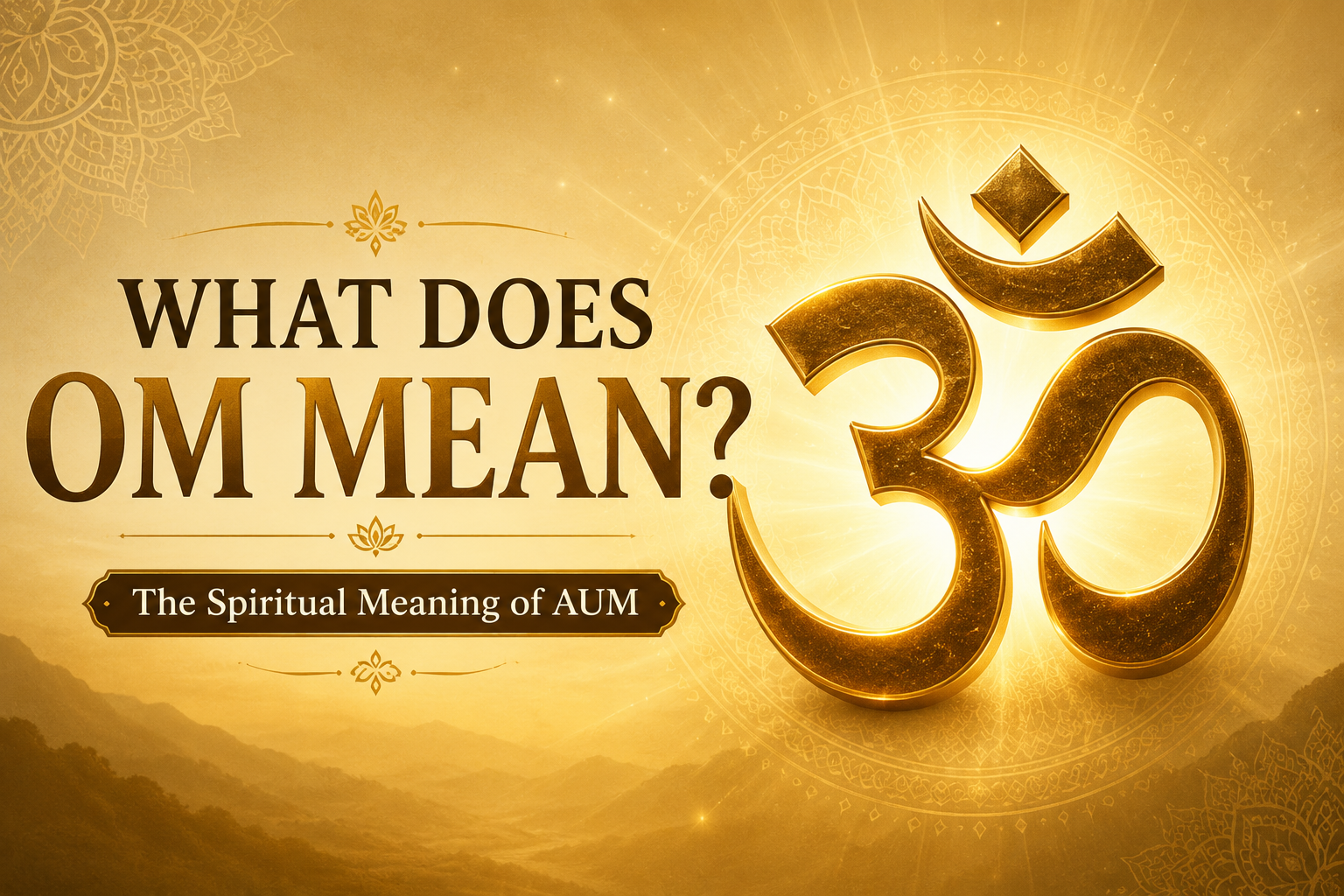
Om (also spelled Aum) is one of the most sacred and profound concepts in Indian spirituality, central to Hinduism, Buddhism, Jainism, and Sikhism. It’s a Sanskrit syllable that literally represents the primordial sound—the original vibration from which the entire universe was created. Om goes far deeper than just a simple chant or symbol; it embodies the essence of the entire cosmos and represents the union of your soul with the universe.
The phrase “the whisper of the universe” perfectly captures Om’s essence. This sacred sound teaches us that we are not separate from the universe but connected to its very core through this divine vibration.
The Literal Meaning and Etymology
Om (also written as Aum) comes from the Sanskrit language and is considered the most sacred syllable in Indian religions. In its most basic sense, it literally translates to the number four in Hindi, but its spiritual meaning is far more profound.
In Hindu and Buddhist philosophy, Om evolved to represent:
- Atman – your soul or inner self
- Brahman – the universe and everything in it
Om is not just a sound or symbol. It is the core of our very existence—the entire cosmos, whatever we can see, touch, hear, and feel.
The Core Principle: The Sacred Syllable
How Om Works
Om operates as the fundamental vibration of creation, similar to how the Big Bang theory describes the universe’s origin. When you chant Om:
A (Creation) — The first sound representsBrahma(the creator), symbolizing the beginning and creationU (Manifestation) — The second sound representsVishnu(the maintainer), symbolizing manifestation and continuationM (Destruction) — The third sound represents Shiva (the destroyer), symbolizing transformation and destruction
The key insight is that Om is not just three separate sounds. When chanted, they merge into one unified vibration that represents the entire cycle of existence.
The Three Sounds Represent
The three sounds (a-u-m) represent several important triads:
| Triad | Components |
|---|---|
| Three Gods | Brahma (creator), Vishnu (maintainer), Shiva (destroyer) |
| Three Worlds | Earth, atmosphere, and heaven |
| Three Functions | Thought, speech, and action |
| Three Qualities (Gunas) | Goodness, passion, and darkness |
| Three Vedic Scriptures | Rigveda, Yajurveda, and Samaveda |
Together, these three sounds represent the whole universe joined into a single sound.
Om as the Seed of All Creation
Pranava and Bija Mantra
Om is known as Pranava — “to bow to the divine with folded hands”. It’s also called a bija (seed) mantra, which means it’s the origin seed from which all other sounds and words come.
According to the Yoga Sutras of Patañjali, Om is:
- The first sound of the universe
- The origin seed from which all creation emerged
- The foundation of all sound and words
This means Om is not just one sound among many—it’s the foundation from which all other sounds arise.
What Om Represents
According to Hindu Spiritual Master Amit Ray:
“Om is not just a sound or vibration. It is not just a symbol. It is the entire cosmos, whatever we can see, touch, hear and feel. Moreover, it is all that is within our perception and all that is beyond our perception. It is the core of our very existence.”
Om is:
- God — the divine creative energy
- Knowledge — truth and wisdom
- Everything — the combination of all existence
- Prana — the breath you breathe
- Consciousness — the depth of your awareness
- First vibration — the sound that created the universe
- The sound of the ultimate — the voice of everything that exists
Om Across Different Traditions
In Hinduism
In Hindu philosophy, Om is:
- Considered the very first sound of the universe
- The greatest of all mantras (sacred formulas)
- Signifies the union of Atman (soul) and Brahman (universe)
- The primordial sound from which the entire universe emerged
- Pranava — the foundation of all sound
- A bija mantra — the seed from which all creation comes
In Buddhism
Buddhism views Om:
- Similar to the Hindu meaning
- Represents the totality of sound, existence, and consciousness
- Refers to compassion and connection
In Jainism
In Jainism:
In Sikhism
In Sikhism:
The Om Symbol (ॐ)
What the Symbol Looks Like
The sacred syllable is written as ॐ in Sanskrit.
Symbol Breakdown
| Element | Meaning |
|---|---|
| Curves | Different states of consciousness |
| Crescent | Illusion that separates us from truth |
| Dot | Absolute consciousness, pure awareness |
What the Symbol Represents
- Nirguna — without fixed meaning; mystical and open
- Unification — brings mind, body, and spirit together
- Essence — the entire universe in one symbol
- Primordial sound — cosmic vibration and fundamental unity
How Om Is Used
In Yoga Practice
- Chanted in yoga classes to tune into the higher self
- Used to connect with the universe
- Helps deepen meditation
- Brings mind, body, and spirit together
In Meditation
- Main mantra for Atman (Higher Self)
- Used to attune to your true nature
- Has profound transformative power when chanted
As a Mantra
- Pranava — foundation of all sound
- Bija mantra — origin seed from which all sounds come
- According to Yoga Sutras: first seed of all creation
Key Insights About Om
The Profound Meaning
“Om is the core of our very existence“
Common Sayings
Today, people commonly associate Om with:
- “The whisper of the universe“
- “The voice of everything“
- “The first sound of creation“
- “The universal heartbeat“
What Om Means in One Sentence
Om represents the union of your soul with the entire universe — connecting inner self with cosmic consciousness.
How to Use Om in Your Practice
1. Chant with Awareness
- Practice observing your thoughts without identifying with them
- Act as a witness to your chanting
- Develop mindfulness while chanting
2. Focus on the Vibration
- Feel the gentle vibration in your body
- Pay attention to how your breath settles
- Connect with your inner self
3. Connect to the Universe
Common Misconceptions About Om
Misconception 1: “Om is Just a Sound”
Reality: Om is not just a sound or vibration. It is the entire cosmos — whatever we can see, touch, hear, and feel. It’s the core of existence itself.
Misconception 2: “Om is Only for Hinduism”
Reality: Om is sacred across multiple traditions — Hinduism, Buddhism, Jainism, and Sikhism all use it.
Misconception 3: “Om Has One Fixed Meaning”
Reality: Om is Nirguna — without fixed meaning. It’s mystical, open, and can represent different aspects of consciousness.
Misconception 4: “Om is Just for Yoga”
Reality: Om is used in meditation, prayer, rituals, and spiritual practices beyond just yoga.
The Ultimate Goal: Connecting with Divine Consciousness
The Purpose of Om
In both Hinduism and Buddhism, chanting Om is meant to:
- Connect with the higher self
- Tune into universal consciousness
- Attune to your true nature (Atman)
- Deepen meditation
The Key Insight
The key to Om is understanding its depth:
- When you chant with awareness, you align with your true nature
- Om represents the essence behind everything you perceive
- Chanting connects you with the divine creative force
Conclusion
Om is not just a simple sound or symbol. It’s a vast, profound, and mystical concept that encompasses the entire universe. The principle teaches us that:
- We are connected to the universe through this divine vibration
- Om represents Atman + Brahman — your soul united with everything
- The three sounds (A-U-M) represent the entire cycle of existence
- Om is the foundation from which all creation emerged
- Awareness matters — chanting with consciousness aligns you with truth
Understanding Om empowers us to connect with our higher self, deepen our meditation, and realize our unity with the universe. As the saying goes: “Om is the core of our very existence“.
The work of Om is to unite us with divine consciousness, creating a bridge between the inner self and the cosmic reality. Through mindful chanting and awareness, we can transform our spiritual practice and connect with the primordial sound that created the universe.