Sanatan Dharma means the eternal way of life or the eternal law that guides human beings toward truth, duty, peace, and spiritual growth. It is a term commonly used for Hinduism and refers to principles that are considered timeless, universal, and not limited to one place, one founder, or one period in history.
Introduction
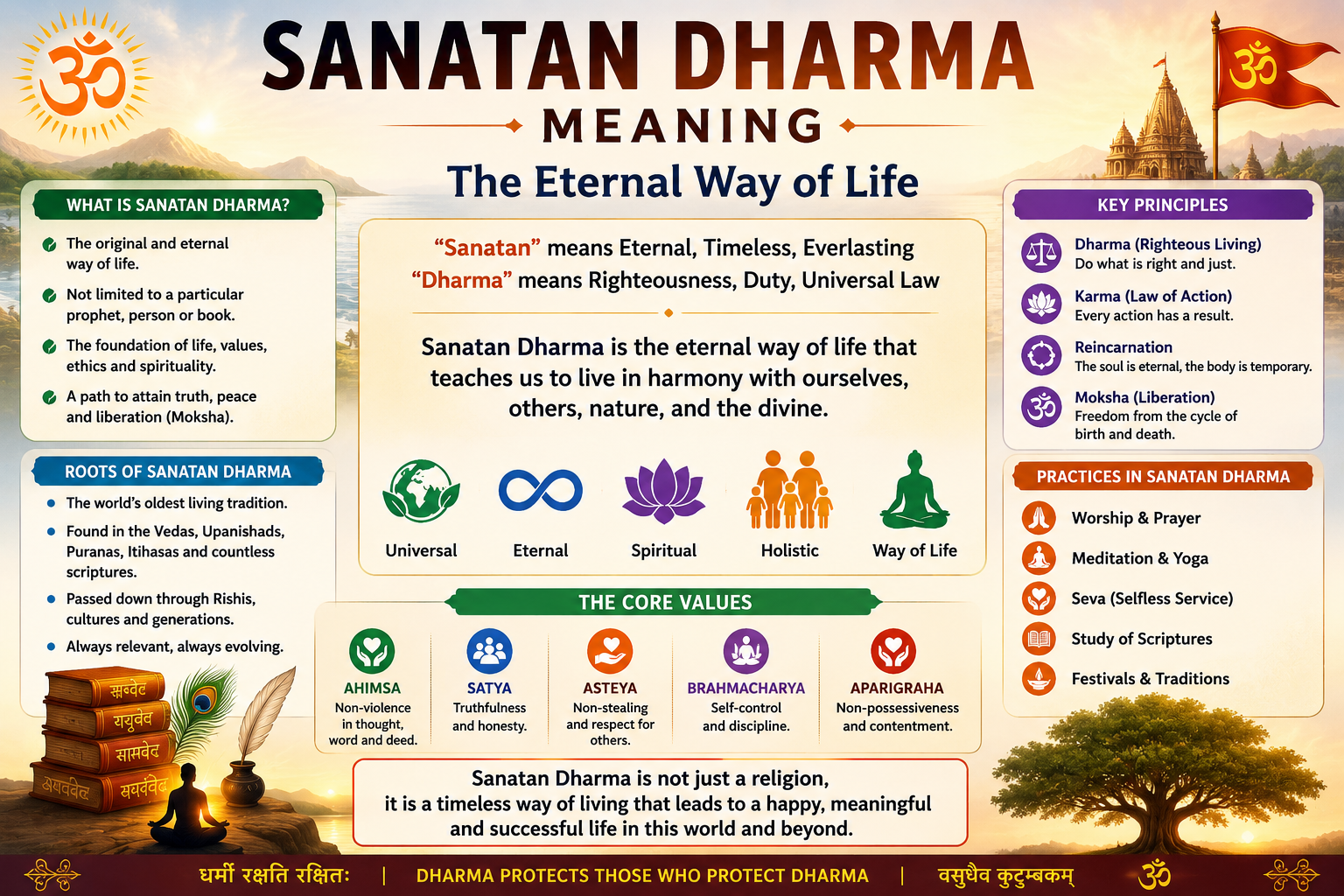
Sanatan Dharma is one of the most important ideas in Hindu philosophy. The phrase combines two Sanskrit words: “Sanatan,” meaning eternal or everlasting, and “Dharma,” meaning duty, law, righteousness, or the principle that sustains life. Together, the term expresses the belief that there is a timeless order in the universe and in human life that should be understood and followed.
Many people use Sanatan Dharma as another name for Hinduism, but the term carries a deeper meaning. It suggests that spiritual truth is not created by one person or one moment in history; instead, it has always existed and continues to guide human beings. Because of this, Sanatan Dharma is often described not merely as a religion, but as a complete way of living.
For beginners, the idea can be understood simply: Sanatan Dharma teaches people how to live with truth, balance, responsibility, compassion, and spiritual awareness. It gives meaning to life beyond material success and points toward inner growth and liberation.
Meaning of the words
The word “Sanatan” means that which is eternal, without beginning and without end. It refers to something that is always true and not limited by time. This is why the term is used to describe spiritual principles that are believed to remain valid in every age.
The word “Dharma” is more complex. It can mean duty, righteousness, moral order, natural law, or the principle that holds life together. In Hindu thought, dharma is not only about religion in the narrow sense; it is also about behaving in a way that supports harmony within oneself, family, society, and the world.
When these two words are joined, Sanatan Dharma means the eternal law or eternal path that sustains existence. It is the way that preserves truth, justice, and spiritual order in life.
Why it is called eternal
Sanatan Dharma is called eternal because its teachings are believed to apply to all people, at all times, and in all places. It is not limited to one prophet, one book, or one historical event. Instead, it is seen as a universal spiritual framework that reflects the deepest realities of life.
This eternal nature is also connected to the idea that truth does not change even when cultures, languages, and societies change. Outer forms may differ, such as rituals, temples, and customs, but the underlying spiritual values remain the same. These include truth, self-control, compassion, devotion, and the search for liberation.
Because of this, Sanatan Dharma is often described as both ancient and ever-new. Its teachings are considered old in origin but fresh in relevance because they speak to the same human questions that exist today.
Core principles
Dharma
Dharma is the foundation of Sanatan Dharma. It means living rightly, fulfilling one’s duties, and maintaining order in life. A student, parent, worker, ruler, or teacher may all have different duties, but each role is guided by dharma.
Karma
Karma means action and the results of action. Every thought, word, and deed creates an effect. Good actions create beneficial results, while harmful actions lead to suffering or difficulty. This idea teaches responsibility and self-awareness.
Samsara
Samsara is the cycle of birth, death, and rebirth. According to Hindu belief, the soul continues its journey through many lives until it becomes free through spiritual realization.
Moksha
Moksha means liberation. It is freedom from ignorance, suffering, and the cycle of rebirth. In many Hindu traditions, it is the highest goal of human life.
Sanatan Dharma and Hinduism
Sanatan Dharma and Hinduism are closely connected, and in many contexts the terms are used together. Britannica notes that the phrase “sanatana dharma” has been used in Hinduism to describe the eternal duties or practices that apply to all Hindus.
However, the term Sanatan Dharma can also be understood more broadly as the spiritual foundation behind Hindu life. It includes philosophy, ethics, worship, meditation, temple traditions, pilgrimage, and the search for truth.
For beginners, the easiest way to think about it is this: Hinduism is the living tradition, and Sanatan Dharma is the eternal principle that gives that tradition its spiritual depth and meaning.
Spiritual vision
Sanatan Dharma sees life as meaningful and purposeful. Human beings are not considered accidental or meaningless; they are seen as souls on a journey toward self-understanding and liberation. This journey involves learning, doing one’s duty, serving others, and seeking the divine.
It also teaches that the divine may be approached in many ways. Some people worship a personal God, while others focus on the formless absolute. This openness allows different paths of devotion and meditation to exist within the same spiritual framework.
In this sense, Sanatan Dharma is not rigid. It welcomes diversity while still holding on to core values that sustain spiritual life.
Sacred texts
Sanatan Dharma is supported by a vast body of sacred texts, not just one scripture. The Vedas are the oldest and most foundational texts, while the Upanishads explore deeper spiritual truths about the self and ultimate reality.
The Bhagavad Gita is especially important because it presents practical spiritual teaching in the form of a conversation between Krishna and Arjuna. It explains duty, devotion, wisdom, and action without attachment.
The Ramayana and Mahabharata are also central. They are epic narratives that teach moral lessons, family values, devotion, courage, and the consequences of choice. Together, these texts shape how many Hindus understand Sanatan Dharma in daily life.
Daily life
Sanatan Dharma is not only about prayer or philosophy; it also influences daily conduct. It encourages truthfulness, discipline, respect for elders, compassion toward others, and mindfulness in action. These values are meant to make life balanced and meaningful.
Many Hindus begin the day with prayer, mantra chanting, or meditation. Families may worship at home, visit temples, observe fasts, or celebrate festivals together. These practices help connect daily life with spiritual awareness.
The idea is that every ordinary action can become sacred if it is done with sincerity, gratitude, and responsibility. That is one reason Sanatan Dharma is often called a way of life rather than only a religion.
Festivals and worship
Festivals are a major part of Sanatan Dharma because they combine devotion, memory, community, and joy. Celebrations such as Diwali, Holi, Navratri, Janmashtami, and Shivaratri are connected to divine stories and spiritual meanings.
Worship may include puja, aarti, offerings, chanting, fasting, pilgrimage, and acts of service. These practices are not meant only as ritual routines; they are meant to develop discipline, gratitude, and connection with the divine.
Different regions and communities may celebrate in different ways, but the inner purpose is often the same: to remember the divine and strengthen spiritual life.
Why beginners should understand it
For beginners, understanding Sanatan Dharma is important because it gives a broader and more respectful view of Hinduism. It shows that Hindu tradition is not based on one narrow rulebook but on a deep and flexible spiritual vision.
It also helps readers understand why Hindus value pilgrimage, ritual, meditation, duty, and self-realization. These are not separate ideas; they are all part of the same larger path.
Most importantly, it shows that Sanatan Dharma is about living in harmony with truth, the self, society, and the universe.
Conclusion
Sanatan Dharma means the eternal way of life, the eternal law, or the timeless spiritual path that guides human beings toward truth and liberation. It is a broad and ancient tradition that includes duty, karma, rebirth, devotion, sacred texts, worship, and the pursuit of moksha.
For a beginner, the central message is simple: live with truth, act with responsibility, respect the divine, and seek inner freedom. That is the heart of Sanatan Dharma.