
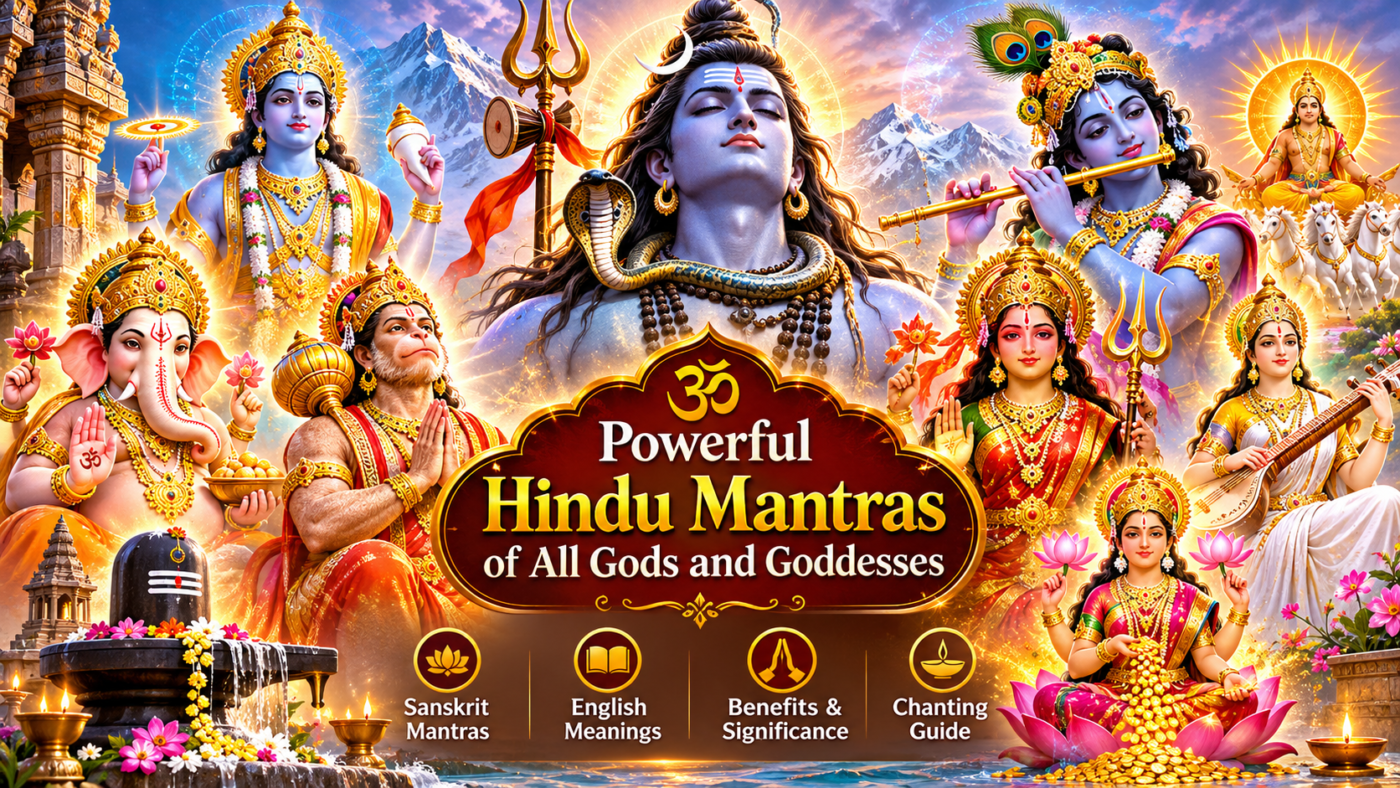
Powerful Hindu Mantras of All Gods and Goddesses
Discover sacred Hindu mantras dedicated to Lord Shiva, Lord Vishnu, Lord Krishna, Lord Ganesha, Goddess Durga, Goddess Lakshmi, Lord Hanuman and other deities.
Explore Sanskrit Mantras, English Meanings and Traditional Chanting Practices.
Hinduism has a rich tradition of sacred mantras used in prayer, meditation and spiritual worship. These mantras are dedicated to different gods and goddesses and are traditionally recited to express devotion, seek blessings and cultivate inner peace.
Table of Contents
- Lord Shiva Mantra
- Lord Vishnu Mantra
- Lord Krishna Mantra
- Lord Ganesha Mantra
- Lord Hanuman Mantra
- Goddess Durga Mantra
- Goddess Lakshmi Mantra
- Goddess Saraswati Mantra
- Lord Rama Mantra
- Surya Dev Mantra
- Gayatri Mantra
- Shanti Mantra
1. Lord Shiva Mantra
ॐ नमः शिवाय
Transliteration: Om Namah Shivaya
Meaning: I bow to Lord Shiva, the supreme consciousness.
Traditional significance: This is one of the most widely recited Shiva mantras. Devotees chant it as an expression of devotion and spiritual reflection.
2. Lord Vishnu Mantra
ॐ नमो भगवते वासुदेवाय
Transliteration: Om Namo Bhagavate Vasudevaya
Meaning: I offer my salutations to Lord Vasudeva, a form of Lord Vishnu.
Traditional significance: A devotional mantra associated with Lord Vishnu and bhakti.
3. Lord Krishna Mantra
हरे कृष्ण हरे कृष्ण कृष्ण कृष्ण हरे हरे।
हरे राम हरे राम राम राम हरे हरे॥
Transliteration: Hare Krishna Hare Krishna Krishna Krishna Hare Hare, Hare Rama Hare Rama Rama Rama Hare Hare.
Meaning: A devotional invocation of Lord Krishna and Lord Rama.
Traditional significance: Widely recited in the Vaishnava tradition and congregational chanting.
4. Lord Ganesha Mantra
ॐ गं गणपतये नमः
Transliteration: Om Gam Ganapataye Namah
Meaning: Salutations to Lord Ganesha.
Traditional significance: Devotees invoke Ganesha at the beginning of prayers and new undertakings.
5. Lord Hanuman Mantra
ॐ हं हनुमते नमः
Transliteration: Om Ham Hanumate Namah
Meaning: Salutations to Lord Hanuman.
Traditional significance: Associated with devotion, courage and dedication to Lord Rama.
6. Goddess Durga Mantra
ॐ दुं दुर्गायै नमः
Transliteration: Om Dum Durgayai Namah
Meaning: Salutations to Goddess Durga.
Traditional significance: Recited by devotees in worship of the Divine Mother.
7. Goddess Lakshmi Mantra
ॐ श्रीं महालक्ष्म्यै नमः
Transliteration: Om Shreem Mahalakshmyai Namah
Meaning: Salutations to Goddess Mahalakshmi.
Traditional significance: Devotees worship Goddess Lakshmi as the deity associated with prosperity and abundance.
8. Goddess Saraswati Mantra
ॐ ऐं सरस्वत्यै नमः
Transliteration: Om Aim Saraswatyai Namah
Meaning: Salutations to Goddess Saraswati.
Traditional significance: Associated with learning, knowledge, music and wisdom.
9. Lord Rama Mantra
श्री राम जय राम जय जय राम
Transliteration: Shri Ram Jai Ram Jai Jai Ram
Meaning: Victory and glory to Lord Rama.
Traditional significance: A devotional chant expressing love and reverence for Lord Rama.
10. Surya Dev Mantra
ॐ सूर्याय नमः
Transliteration: Om Suryaya Namah
Meaning: Salutations to the Sun God.
Traditional significance: Recited in traditional worship of Surya Dev, especially during morning prayers.
11. Gayatri Mantra
ॐ भूर्भुवः स्वः।
तत्सवितुर्वरेण्यं।
भर्गो देवस्य धीमहि।
धियो यो नः प्रचोदयात्॥
Transliteration: Om Bhur Bhuvah Swah, Tat Savitur Varenyam, Bhargo Devasya Dhimahi, Dhiyo Yo Nah Prachodayat.
Meaning: We meditate upon the divine light of Savitr and pray for the illumination of our intellect.
Traditional significance: A revered Vedic mantra traditionally associated with wisdom and spiritual contemplation.
12. Maha Mrityunjaya Mantra
ॐ त्र्यम्बकं यजामहे सुगन्धिं पुष्टिवर्धनम्।
उर्वारुकमिव बन्धनान्मृत्योर्मुक्षीय मामृतात्॥
Transliteration: Om Tryambakam Yajamahe Sugandhim Pushtivardhanam, Urvarukamiva Bandhanan Mrityor Mukshiya Maamritat.
Meaning: A prayer to the three-eyed Lord Shiva, seeking liberation from the bonds of death and spiritual freedom.
Traditional significance: A revered Shiva mantra traditionally recited in prayers for well-being and spiritual reflection.
13. Shanti Mantra
ॐ शान्तिः शान्तिः शान्तिः
Transliteration: Om Shanti Shanti Shanti
Meaning: Peace, peace, peace.
Traditional significance: Often recited at the conclusion of prayers and spiritual gatherings.
How to Chant Hindu Mantras
- Choose a quiet and clean place for prayer or meditation.
- Sit comfortably and take a few calm breaths.
- Focus your attention on the deity or the meaning of the mantra.
- Recite the mantra respectfully, aloud or silently.
- Follow the tradition associated with the mantra if you have a specific practice.
- End your prayer with gratitude and peace.
Frequently Asked Questions
1. Which Hindu mantra is commonly chanted every day?
Om Namah Shivaya, Gayatri Mantra and Om Namo Bhagavate Vasudevaya are among the widely recited Hindu mantras.
2. Can beginners chant Hindu mantras?
Many commonly recited devotional mantras can be learned by beginners. Follow the pronunciation and customs of the tradition you follow.
3. How many times should a mantra be chanted?
Some traditions use 108 repetitions, while others follow different practices. There is no single number that applies to every mantra.
4. Can I chant mantras in English pronunciation?
Yes. Beginners can use transliteration to learn pronunciation, although learning the Sanskrit sounds is helpful.
5. What is the meaning of Om Namah Shivaya?
It is a devotional salutation to Lord Shiva and is commonly translated as I bow to Lord Shiva.
Explore more: Read our guides on 12 Jyotirlingas, Mahakaleshwar Temple and Hindu Festivals.