
Introduction: A Timeless Story from Indian Mythology
India is a land full of powerful stories, spiritual wisdom, and deep meanings. One of the most famous and meaningful stories in Hindu mythology is the Samudra Manthan, also known as the Churning of the Ocean.
This story is not just about gods and demons fighting for power. It is about teamwork, patience, struggle, and the ultimate victory of good over evil.
Even today, people across India—from Uttar Pradesh to Gujarat, from Tamil Nadu to Himachal—listen to this story during religious events, festivals, and spiritual gatherings.
Let’s understand this story in simple language.
What is Samudra Manthan?
Samudra Manthan means “churning of the ocean”.
In this event, the Devas (gods) and Asuras (demons) worked together to churn the ocean to get Amrit, the nectar of immortality.
Amrit had the power to make anyone immortal and extremely powerful.
Why Did Gods Need Amrit?
Once, the gods became weak due to a curse by a sage.
Because of this:
- They lost their strength
- They were defeated by demons
- They were in danger of losing control over the universe
The king of gods, Indra, went to Lord Vishnu for help.
Lord Vishnu suggested a plan:
“Churn the ocean to get Amrit. It will restore your power.”
The Agreement Between Gods and Demons
The gods alone were not strong enough to churn the ocean.
So, they made a deal with the demons:
“Let’s work together and share the Amrit.”
The demons agreed, hoping to become immortal.
How Was the Ocean Churned?
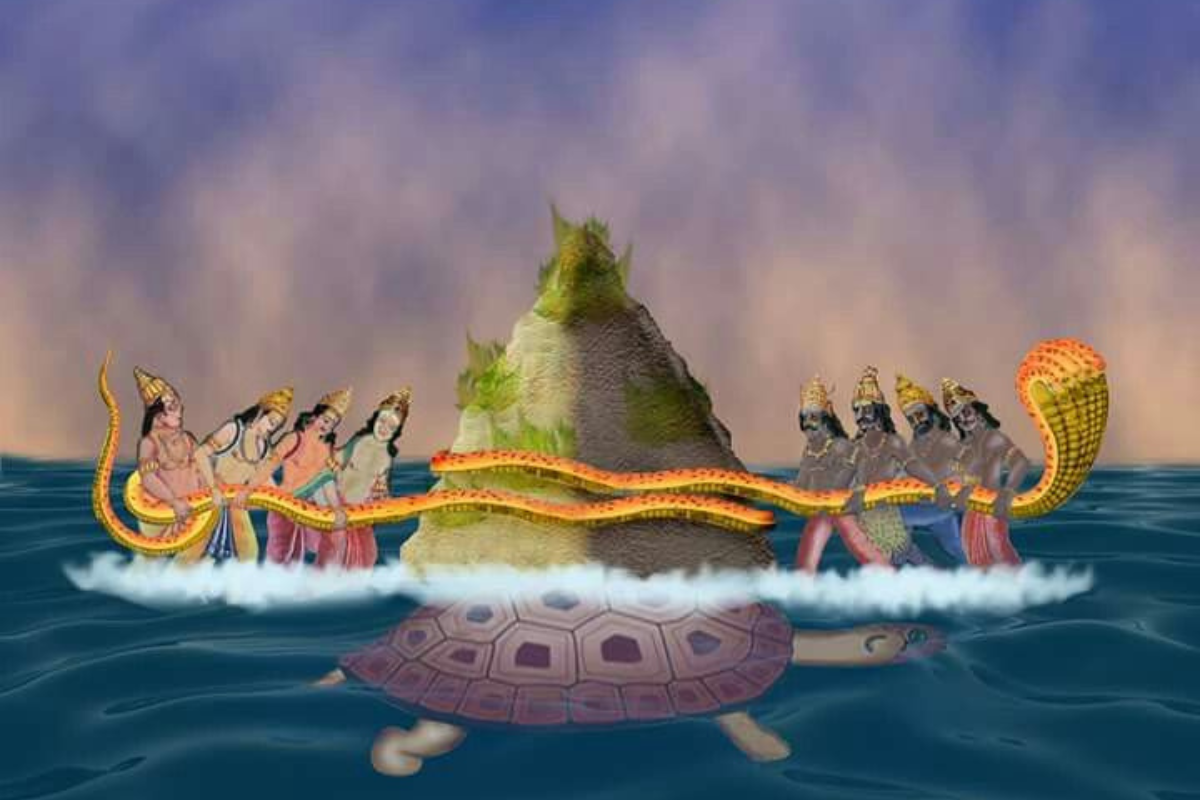
To churn such a massive ocean, they needed special tools:
- Mount Mandara → Used as the churning rod
- Vasuki (giant serpent) → Used as the rope
- Kurma Avatar of Lord Vishnu → Supported the mountain
Lord Vishnu took the form of a tortoise and held the mountain on his back to keep it stable.
The Churning Process Begins
The gods and demons started pulling the serpent Vasuki from opposite sides:
- Gods held the tail
- Demons held the head
As they churned, the ocean began to produce many divine and dangerous things.
The Deadly Poison: Halahal
The first thing that came out was a deadly poison called Halahal.
It was so powerful that it could destroy the entire universe.
Everyone became afraid.
At that moment, Lord Shiva stepped forward and drank the poison to save the world.
His throat turned blue, and he became known as Neelkanth.
This shows:
Sometimes, great sacrifices are needed to protect others.
The Divine Treasures (14 Ratnas)
As the churning continued, many precious and divine items came out of the ocean.
Some important ones include:
- Kamdhenu – Wish-fulfilling cow
- Kalpavriksha – Wish-fulfilling tree
- Airavat – Indra’s elephant
- Kaustubh Mani – Divine jewel
- Goddess Lakshmi – Goddess of wealth
- Chandra (Moon)
- Uchhaishrava – Divine horse
- Dhanvantari – God of medicine with Amrit
Each treasure had its own importance and meaning.
Appearance of Goddess Lakshmi
One of the most important moments was when Goddess Lakshmi appeared.
She chose Lord Vishnu as her husband.
This symbolized that wealth always supports righteousness and truth.
The Arrival of Amrit
Finally, after a long struggle, Dhanvantari appeared holding the pot of Amrit.
Now, the real conflict began.
Both gods and demons wanted the Amrit.
The Clever Trick by Lord Vishnu
To solve this problem, Lord Vishnu took the form of a beautiful woman called Mohini.
She distracted the demons with her beauty and charm.
She promised to distribute Amrit equally.
But cleverly:
- She gave Amrit only to the gods
- The demons were left out
This ensured the victory of good over evil.
The Story of Rahu and Ketu
One demon disguised himself and sat among the gods.
He managed to drink some Amrit.
But the Sun and Moon recognized him and informed Vishnu.
Vishnu immediately cut his head.
However:
- His head became Rahu
- His body became Ketu
Even today, they are believed to cause eclipses.
Spiritual Meaning of Samudra Manthan
This story is not just a myth—it has deep spiritual meaning.
Ocean = Human Mind
Our mind is like a deep ocean filled with thoughts.
Gods & Demons = Good & Bad Thoughts
We all have both positive and negative sides.
Churning = Effort
Success comes only after continuous effort.
Poison = Problems
Every journey starts with difficulties.
Amrit = Success
After patience and hard work, we achieve happiness and success.
Life Lessons We Can Learn
Here are simple lessons we can apply in real life:
- Work together—even with opponents
- Be patient—results take time
- Face problems bravely
- Stay focused on your goal
- Goodness always wins
Importance of Samudra Manthan in India
This story is very popular across India:
- Told in temples and religious gatherings
- Shown in TV serials and books
- Connected with festivals and beliefs
In places like Uttar Pradesh, Varanasi, and Mathura, people deeply believe in its spiritual meaning.
It is also seen in art, paintings, and temple carvings across India.
Why This Story Still Matters Today
Even in modern life, Samudra Manthan teaches us:
- Success requires effort
- Problems are part of growth
- Teamwork is important
- Right decisions lead to success
Whether you are a student, professional, or business owner, this story gives valuable guidance.
Conclusion
The story of Samudra Manthan is more than just mythology.
It is a powerful lesson about:
- Struggle before success
- The importance of patience
- The victory of good over evil
In today’s fast life, this story reminds us to stay calm, work hard, and trust the process.
Because just like the gods got Amrit after hard work—
You too can achieve success with patience and effort.